Have you ever thought about traveling across America by boat? No really, not around, across; through the rivers and portages taking each snakey way around the land in a trusty motorized boat or canoe. Well Least Heat-Moon did, and with a friend (well a few friends at times) he did just that. Having read his Blue Highways and enjoyed it, I figured this would be a good one too.
Later in life after having traveled the blue highways of America, and with an impending divorce, Least Heat-Moon decides that he wants to take another trip across America. Only this time he wants to do it on a different kind of blue highway. The watery kind. So he buys a little boat, finds some friends who can help him on his way, and maps out a course where he can travel the most by river and by not having to use too many portages. He meets people along the way, stops every night to rest in a different city, and learns what the majority of America's waterways look like.
Least Heat-Moon is a decent narrator. He tells you a lot about himself and the people he travels with. You get to hear a few stories about the people he meets along the way, but really not too many. More often than not he's telling stories about the people he's traveling with's pasts and such. He also treats the boat as if it were a person, and there's a ton of description and history behind the boat and why it's named what it is and why he chose such a boat.
While this was an interesting book I still don't feel as if I know America's waterways. I know the laws, the ways that it has changed due to the damming and infrastructure and population of America, but I don't really recall too much in the way of scenery described. Oh sure there was some, but not the in-depth descriptions I was looking for. And that goes for almost everything aside from the boat itself. I wanted to know more about the people and the nature scenes and I felt that it was a bit lacking in this book. There was a lot of social commentary, a little politics, and a lot of personal history about the author and his friends. Which made it seem more like a memoir than a travel narrative.
An ok book, but not quite what I had expected it to be. If you're fond of Least Heat-Moon's writing, you'll like it.
River Horse
Copyright 1999
502 pages
Showing posts with label nonfiction. Show all posts
April 10, 2015
December 28, 2014
Women Who Run with the Wolves by Clarissa Pinkhola Estes
Admittedly I thought this was going to be a book about women who were
raised in the wild (or raised by wolves, that sort of folklore) as that
is what the title and subtitle seemed to indicate. I was wrong. This
is more of a psychoanalysis book and self-help than a book on myths.
Estes has taken a collection of myths and stories from folklore and dissected them one by one into telling the story of the female subconscious. The motives and actions, the restrictions society has placed on the "wild woman" and the way that women can rediscover their wildness. She gives little lessons and advice for those who have been brought down by society and describes the process of suppressing a woman's instincts. The myths themselves are told regularly and then she adds her interpretation to the mix, showing how it relates to female psychology.
This book is all about women. Men are mentioned but only in relation to women. And more often than not they are the oppressors. Although there are a few mentions of men who encourage the wildness in women. The books total theme was one of oppression though, and I was a bit surprised that even when she was encouraging wildness and restoring women back to themselves, she kept referring to arts, and childbirth, and barely a mention of science. It almost seemed like her vision of taking the female self back was still pretty traditional. She wanted a stronger woman, but one that could paint or write and take back her creativity. This might not be very empowering for those women who rather than have strong skills in the arts, are good in the sciences or math. It just didn't seem to be all encompassing.
I liked the myths in the book but did not enjoy how she dissected one story over and over and over. Once would have been sufficient as I found myself growing bored with the tedium of her repetitiveness. I think at some points it was just an effort to make the book longer. And all of the writing was at that level of descriptiveness. So many words to say the same thing over and over. It made the book a bit of a slog. But, returning back to the myths I think she chose some interesting ones, and there were some that I had never heard before, such as the tale of Baba Yaga and the armless girl. She had a nice variety.
I think this book would have been immensely better if it had been edited down. It had interesting concepts but they were lost in the sheer amount of words and the explanations were repetitive. I just can't recommend it based on that.
Women Who Run With the Wolves
Copyright 1992
520 pages
Estes has taken a collection of myths and stories from folklore and dissected them one by one into telling the story of the female subconscious. The motives and actions, the restrictions society has placed on the "wild woman" and the way that women can rediscover their wildness. She gives little lessons and advice for those who have been brought down by society and describes the process of suppressing a woman's instincts. The myths themselves are told regularly and then she adds her interpretation to the mix, showing how it relates to female psychology.
This book is all about women. Men are mentioned but only in relation to women. And more often than not they are the oppressors. Although there are a few mentions of men who encourage the wildness in women. The books total theme was one of oppression though, and I was a bit surprised that even when she was encouraging wildness and restoring women back to themselves, she kept referring to arts, and childbirth, and barely a mention of science. It almost seemed like her vision of taking the female self back was still pretty traditional. She wanted a stronger woman, but one that could paint or write and take back her creativity. This might not be very empowering for those women who rather than have strong skills in the arts, are good in the sciences or math. It just didn't seem to be all encompassing.
I liked the myths in the book but did not enjoy how she dissected one story over and over and over. Once would have been sufficient as I found myself growing bored with the tedium of her repetitiveness. I think at some points it was just an effort to make the book longer. And all of the writing was at that level of descriptiveness. So many words to say the same thing over and over. It made the book a bit of a slog. But, returning back to the myths I think she chose some interesting ones, and there were some that I had never heard before, such as the tale of Baba Yaga and the armless girl. She had a nice variety.
I think this book would have been immensely better if it had been edited down. It had interesting concepts but they were lost in the sheer amount of words and the explanations were repetitive. I just can't recommend it based on that.
Women Who Run With the Wolves
Copyright 1992
520 pages
May 07, 2013
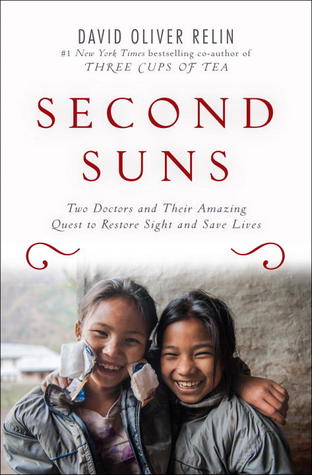
Second Suns by David Oliver Relin
**This review is part of the Amazon Vine Program**So, despite it being mentioned in this book that the work of the people in it has been featured on television programs and numerous articles, I'd never heard of any of them before this book. And that's really a shame, because what they are doing is so fantastic that it should be a constant topic of conversation everywhere. Hopefully, this book being published can change that.
The author, Relin, is a journalist who has worked on other books (most notably, Three Cups of Tea). In this one, he chronicles the work of Geoffrey Tabin and Sanduk Ruit, two doctors who have teamed together over the past couple of decades to restore sight to the numerous poor blind in the Himalayas, and then on to other countries. Their organization, Himalayan Cataract Project, was founded in 1995 and since then has reached out to Africa, India, Nepal, Bhutan, China, and so many other countries where these men have performed a simple but effective surgery to replace cataracts with a cheaply made clear lens and give back sight to so many people who wouldn't have had the chance otherwise. The book also goes over their early careers and lives and what drew them to this line of work.
The sad passing of Relin in November 2012 is made even more tragic by the amount of work he has placed into this book. Relin takes the backseat but I think even he failed to realize what a difference he made just in writing this book. Sure he wasn't the one performing the surgeries, but by showing the work of these two doctors he's probably gained them tons of support they need that they wouldn't have gotten otherwise. He's brought their cause to light and to a wide audience of people. And that is something admirable and wonderful. Tabin and Ruit, the two doctors featured in this book are also pretty spectacular people as well. While I didn't enjoy reading about Tabin as much as I did Ruit (Ruit's background and personality was more engaging to me) I recognize that they are both experts in their field and obviously filled with generous hearts and ambitions. The way they are presented in this book is very real (Ruit's temper and Tabin's bouncing around) and they aren't perfect by any means. But they're such good people you can forgive them their imperfections. And the people they surround themselves with are all pretty extraordinary as well.
The book is very well done. While I thought the pace could have been better at the beginning of the book, it really engages you in the middle and end and you keep reading to see how many more lives are changed by these doctors. The beginning was mostly about Tabin and his path to becoming a doctor, and seeing as how I'm not a climber, it didn't really resonate with me and hold my interest. In contrast, Ruit's meager roots and how he achieved his success was very inspiring and held my attention. And the work they did together was also just as interesting. For some readers, the descriptions of the eye surgery and occasional mentions of blood might be off-putting, but I think they just show what kind of conditions the doctors are working with and how well they do their jobs despite adversity.
This is definitely a book to read if you enjoy inspiring stories and people who are making a difference in the world. Truly, I hope to hear more and more about the work Tabin and Ruit are doing.
Second Suns
Copyright 2013
407 pages
January 15, 2013
The Springs of Namje by Rajeev Goyal
In my quest to find out if the Peace Corps is right for me, I'm picking
up as many books about travel and the Peace Corps itself to read about
other's experiences and memories of their time. This was a very good
book, and it certainly gave me a lot more history on the Peace Corps
than I knew before.
Rajeev Goyal spent two years in the Peace Corps in Nepal. First in one village where he was teaching, but was moved because of upheaval caused by the political tensions in Nepal, and then to Namje, a small town where he also taught. But he did much more than teach in Namje, because it was a village with scarce access to water, Goyal started an initiative to create a pump to pump water from a distant river to the town. His goal was to better the lives of the people there. After his term was over, he moved on to Washington DC, where he became part of an initiative to secure more funding for the Peace Corps. The goal was 450 Million, and the amount asked for equivalent to 5-6 hours of what we spend on our forces in Iraq (figures obtained from the book). That's right, it's in the millions, which when it comes to a government agency, is a small number. He details his struggle at getting this amount and the lobbying he does with lessons learned from his time in the Peace Corps. In the last part of the book, he returns to Namje and Nepal to further work at improving peoples lives through permaculture programs.
Goyal is very generous to those people he gives descriptions of in Nepal. It was easy to see that he really connected with the people in the villages and had great respect for them. He truly wanted to get to know their culture and not change it, but improve living conditions for them. I would say he definitely embodied what the Peace Corps is supposed to be about. When he returns to DC his descriptions are less than flattering of some of the government officials that he has to deal with, but seeing his plight I can kind of agree with him on some of those descriptions. It's hard to face so many walls when you're not asking for much in the grand scheme of things. But even when he's being unflattering I think he is still fair, he never outright insults anyone who turns him down (excepting one representative from TX and I completely agree with him on his thoughts for that guy).
I enjoyed the part of the book that Goyal spent in Nepal. It was descriptive, inspiring, and it really made me see what good a volunteer can do. Not that everything Goyal did was good; he was very realistic in the failures he had as well and what he learned from them. The part where he's running around DC I wasn't as fond of. It's not that it wasn't informative, it certainly was. But it was so rushed and so many names mentioned that I could feel myself getting confused and having to reread paragraphs several times to get an idea of what he was doing. I think slowing it down and expanding on that section could have done a world of good for the book. As it was, I still got the importance of the matter and the disappointment when the requested funding didn't come through for the Peace Corps. One can only hope that in the future that will change. Because it deals with politics as well, there are bound to be some people who are insulted by the ideas presented in this book. I don't think Goyal leans too heavily towards any one party, but I also know when it comes to politics people have strong opinions.
I would have liked to see more on the results of the work he's doing in Nepal now, but it's understandable that it's not included. This book was published and he's still working on it so hopefully another book is still in the making. I would definitely read it if there was one. A splendid book on a Peace Corps member's experience and an inspiring way to look at changing policy in DC, I would definitely recommend this book.
The Springs of Namje
Copyright 2012
210 pages
Rajeev Goyal spent two years in the Peace Corps in Nepal. First in one village where he was teaching, but was moved because of upheaval caused by the political tensions in Nepal, and then to Namje, a small town where he also taught. But he did much more than teach in Namje, because it was a village with scarce access to water, Goyal started an initiative to create a pump to pump water from a distant river to the town. His goal was to better the lives of the people there. After his term was over, he moved on to Washington DC, where he became part of an initiative to secure more funding for the Peace Corps. The goal was 450 Million, and the amount asked for equivalent to 5-6 hours of what we spend on our forces in Iraq (figures obtained from the book). That's right, it's in the millions, which when it comes to a government agency, is a small number. He details his struggle at getting this amount and the lobbying he does with lessons learned from his time in the Peace Corps. In the last part of the book, he returns to Namje and Nepal to further work at improving peoples lives through permaculture programs.
Goyal is very generous to those people he gives descriptions of in Nepal. It was easy to see that he really connected with the people in the villages and had great respect for them. He truly wanted to get to know their culture and not change it, but improve living conditions for them. I would say he definitely embodied what the Peace Corps is supposed to be about. When he returns to DC his descriptions are less than flattering of some of the government officials that he has to deal with, but seeing his plight I can kind of agree with him on some of those descriptions. It's hard to face so many walls when you're not asking for much in the grand scheme of things. But even when he's being unflattering I think he is still fair, he never outright insults anyone who turns him down (excepting one representative from TX and I completely agree with him on his thoughts for that guy).
I enjoyed the part of the book that Goyal spent in Nepal. It was descriptive, inspiring, and it really made me see what good a volunteer can do. Not that everything Goyal did was good; he was very realistic in the failures he had as well and what he learned from them. The part where he's running around DC I wasn't as fond of. It's not that it wasn't informative, it certainly was. But it was so rushed and so many names mentioned that I could feel myself getting confused and having to reread paragraphs several times to get an idea of what he was doing. I think slowing it down and expanding on that section could have done a world of good for the book. As it was, I still got the importance of the matter and the disappointment when the requested funding didn't come through for the Peace Corps. One can only hope that in the future that will change. Because it deals with politics as well, there are bound to be some people who are insulted by the ideas presented in this book. I don't think Goyal leans too heavily towards any one party, but I also know when it comes to politics people have strong opinions.
I would have liked to see more on the results of the work he's doing in Nepal now, but it's understandable that it's not included. This book was published and he's still working on it so hopefully another book is still in the making. I would definitely read it if there was one. A splendid book on a Peace Corps member's experience and an inspiring way to look at changing policy in DC, I would definitely recommend this book.
The Springs of Namje
Copyright 2012
210 pages
January 14, 2013
A Dose of Tia by Dina Mauro
**This book was received as a free advanced reviewers copy**
I've always wanted to do more volunteering. But work, commutes, and other things have led me to believe that I just don't have the time. Which is false, I do, but I need to find a volunteer opportunity that I'm passionate about. Which is what Mauro explains and lives in this book. She shows that if you have passion, it's not an obligation, but rather a way of life.
Through little stories and vignettes, Mauro tells about how she adopted Tia, her dog that goes with her on volunteering jaunts, stories of the patients they visit, and just different lessons she learns about life while volunteering. Sometimes she relates conversations that she has with patients while other times she shares the musings in her head as Tia visits with them and she waits quietly. At the end of the book, she provides resources for those looking for volunteer opportunities.
Although short, the stories offer a look into different patients lives and while we don't know medically what's wrong with them, we get to see a different side. A side that tells about pets at home, family life, or just old stories that they feel a need to share. And even though the stories are short, they are detailed enough that you get an idea of what the volunteering time was like. About herself she shares her feelings and her goal to try to stay positive, and even a small glimpse into her family life. So you know the person who's working with the dog Tia, even if everyone they visit is more interested in Tia (which is fine by the author).
The book is almost like a series of short stories and thoughts. And it jumps around a little bit, but it's still highly readable. I was a tad disappointed that there wasn't more about Tia herself. The volunteering was more of a main focus than the dog, which somewhat belies the huge picture of Tia on the front of the book. But for those looking for an inspirational book about volunteering, this fits. My only other complaint would be that the conversations Mauro had with people seemed more simplistic than they would be in real life. I'm sure this is partly because they are recalled from memory, but I just picture conversations as having more detail than what they are portrayed here as. Still, it's not that distracting and having a warm, happy read is nice when there are so many books out there that focus on the bad instead of the good.
If you're interested in volunteering or enjoy stories about animals and people working good deeds, this is probably a good book for you. Short, sweet and simple, it expresses why someone would volunteer their time for a good cause.
A Dose of Tia
Copyright 2012
142 pages
I've always wanted to do more volunteering. But work, commutes, and other things have led me to believe that I just don't have the time. Which is false, I do, but I need to find a volunteer opportunity that I'm passionate about. Which is what Mauro explains and lives in this book. She shows that if you have passion, it's not an obligation, but rather a way of life.
Through little stories and vignettes, Mauro tells about how she adopted Tia, her dog that goes with her on volunteering jaunts, stories of the patients they visit, and just different lessons she learns about life while volunteering. Sometimes she relates conversations that she has with patients while other times she shares the musings in her head as Tia visits with them and she waits quietly. At the end of the book, she provides resources for those looking for volunteer opportunities.
Although short, the stories offer a look into different patients lives and while we don't know medically what's wrong with them, we get to see a different side. A side that tells about pets at home, family life, or just old stories that they feel a need to share. And even though the stories are short, they are detailed enough that you get an idea of what the volunteering time was like. About herself she shares her feelings and her goal to try to stay positive, and even a small glimpse into her family life. So you know the person who's working with the dog Tia, even if everyone they visit is more interested in Tia (which is fine by the author).
The book is almost like a series of short stories and thoughts. And it jumps around a little bit, but it's still highly readable. I was a tad disappointed that there wasn't more about Tia herself. The volunteering was more of a main focus than the dog, which somewhat belies the huge picture of Tia on the front of the book. But for those looking for an inspirational book about volunteering, this fits. My only other complaint would be that the conversations Mauro had with people seemed more simplistic than they would be in real life. I'm sure this is partly because they are recalled from memory, but I just picture conversations as having more detail than what they are portrayed here as. Still, it's not that distracting and having a warm, happy read is nice when there are so many books out there that focus on the bad instead of the good.
If you're interested in volunteering or enjoy stories about animals and people working good deeds, this is probably a good book for you. Short, sweet and simple, it expresses why someone would volunteer their time for a good cause.
A Dose of Tia
Copyright 2012
142 pages
January 04, 2013
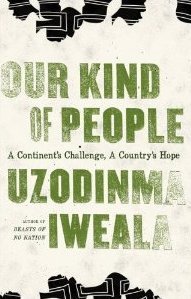
Our Kind of People by Uzodinma Iweala
I've read "Beasts of No Nation" and thought it was a good, insightful book. So when I saw this book by the same author, and saw that it dealt with another hard topic, I decided to give it a try. And I thought the message he was trying to put out there was worthy, certainly viewing AIDS/HIV in a different way than it is commonly perceived is a good thing, but I'm not sure if he pulled it off successfully.
In this nonfiction, Iweala travels back and forth between the United States and his family's native country of Nigeria. Most of this book takes place in Nigeria and centers around the HIV positive people he meets and interviews. It tells the perception of HIV/AIDS in Nigeria, by the people who have it, people who don't, and just the overall thoughts of the disease. It also goes a little bit into the different treatments available that makes this disease no longer have a fatal end and also the different campaigns in Nigeria to try to stop the rampant spread of AIDS/HIV.
I thought he was very fair to the people he described in this book. He told it in a "voice" that seemed authentic and like the stories were actually from the people themselves rather than him completely paraphrasing it. So in that regards the people here are very real and Iweala is able to tell stories that wouldn't normally be told. For himself, he is merely the narrator and while he mentions certain things that relate to him and his family, he doesn't really go into why this topic is so important to him other than having worked in that area in medical school. I guess it would have been nice to really get a feel for why he is so passionate about the subject.
The actual stories from the people he talks to are compelling. And they are the best part of this book. Unfortunately though, they are spaced in such a way and included in with so much other information, that reading this book is somewhat exhausting. It's like holding your breath for a long time while running and then struggling to keep up when you become tired. I think better spacers and a sense of focus would have helped this book. The topic of AIDS/HIV is a hard one to write about as there are so many rumors and falsehoods that Iweala is correct in saying that people with HIV are perceived as different or even bad. But unlike Iweala, I disagree that this focus is on Africans primarily. I think that a bad stigma is placed on anyone with this disease, regardless of where they live in the world or their access to medicine. And that it's just as harsh here as it is there. And while people who aren't promiscuous or share needles get this disease, it shouldn't be ignored that risky behaviors increase the risk of getting the disease. It's not a cultural problem but rather a personal one as each individual contracts the disease for a different reason.
It's a thought provoking book, and I'm glad that Iweala took the time to show us a look at people in Africa with AIDS/HIV and their perception of the disease. You might not learn anything new about the disease from this book, but it does help someone relate to the people who have it and recognize that they are not any different from people who don't have it. A little more focus and this could have been a very outstanding book.
Our Kind of People
Copyright 2012
217 pages
In this nonfiction, Iweala travels back and forth between the United States and his family's native country of Nigeria. Most of this book takes place in Nigeria and centers around the HIV positive people he meets and interviews. It tells the perception of HIV/AIDS in Nigeria, by the people who have it, people who don't, and just the overall thoughts of the disease. It also goes a little bit into the different treatments available that makes this disease no longer have a fatal end and also the different campaigns in Nigeria to try to stop the rampant spread of AIDS/HIV.
I thought he was very fair to the people he described in this book. He told it in a "voice" that seemed authentic and like the stories were actually from the people themselves rather than him completely paraphrasing it. So in that regards the people here are very real and Iweala is able to tell stories that wouldn't normally be told. For himself, he is merely the narrator and while he mentions certain things that relate to him and his family, he doesn't really go into why this topic is so important to him other than having worked in that area in medical school. I guess it would have been nice to really get a feel for why he is so passionate about the subject.
The actual stories from the people he talks to are compelling. And they are the best part of this book. Unfortunately though, they are spaced in such a way and included in with so much other information, that reading this book is somewhat exhausting. It's like holding your breath for a long time while running and then struggling to keep up when you become tired. I think better spacers and a sense of focus would have helped this book. The topic of AIDS/HIV is a hard one to write about as there are so many rumors and falsehoods that Iweala is correct in saying that people with HIV are perceived as different or even bad. But unlike Iweala, I disagree that this focus is on Africans primarily. I think that a bad stigma is placed on anyone with this disease, regardless of where they live in the world or their access to medicine. And that it's just as harsh here as it is there. And while people who aren't promiscuous or share needles get this disease, it shouldn't be ignored that risky behaviors increase the risk of getting the disease. It's not a cultural problem but rather a personal one as each individual contracts the disease for a different reason.
It's a thought provoking book, and I'm glad that Iweala took the time to show us a look at people in Africa with AIDS/HIV and their perception of the disease. You might not learn anything new about the disease from this book, but it does help someone relate to the people who have it and recognize that they are not any different from people who don't have it. A little more focus and this could have been a very outstanding book.
Our Kind of People
Copyright 2012
217 pages
July 28, 2012
Jasmine and Fire: A Bittersweet Year in Beirut by Salma Abdelnour
**This review is part of the Amazon Vine Program**
I've never really thought about Beirut, or even Lebanon much before. Sure I can point to them on a map and I know a little bit, but it's one of the areas of the world that never really captured my attention. I now think that should change, and thanks to this book, I know a little more.
Salma was born in the United States, but with her parents, moved to Lebanon at a very early age. Then, when civil unrest made it dangerous to stay, her parents moved she and her brother back to the United States, to Texas. But she's always felt the longing for Beirut and decides to move back there for a year. Luckily her career as a journalist and writer allows her to do so, even though she'll have to leave behind a relationship to uncertainty and find her way around a city that hasn't been her home in awhile. But as she stays she meets with friends and family, learns about the political unrest and problems the city still has, and samples amazing food.
There is a lot of people to keep track of in this book. Salma is easy enough, since she's the writer, but I never feel as if I'm really getting to know her outside of her relationship woes. Her other feelings just seem to take a back burner. There's a little there, but not as much as I thought there would be. The rest of the people are her friends and relatives and there was just so many that I couldn't keep track of who was who or really gain interest in any of them.
What did capture my interest in this book was the descriptions of the food. I could feel my stomach rumbling as I read and the only thing in my city is a Greek restaurant, which was not nearly the same but the closest I could get. (Yes I did take a break from reading and went to get some food). Everything just sounded so delicious and Salma did a great job describing the different Lebanese dishes. She even included some recipes at the end. I also like the way she touched on the social and religious problems in Beirut. It was enough to make you realize that there are still problems with it, but it wasn't a predominant thing in the book. Which made the book more of an enjoyable read rather than a political one.
An enjoyable read. It made me want to visit Beirut and explore (and eat the food), but I also learned a lot more than I would have expected to about Lebanon.
Jasmine and Fire
Copyright 2012
325 pages
I've never really thought about Beirut, or even Lebanon much before. Sure I can point to them on a map and I know a little bit, but it's one of the areas of the world that never really captured my attention. I now think that should change, and thanks to this book, I know a little more.
Salma was born in the United States, but with her parents, moved to Lebanon at a very early age. Then, when civil unrest made it dangerous to stay, her parents moved she and her brother back to the United States, to Texas. But she's always felt the longing for Beirut and decides to move back there for a year. Luckily her career as a journalist and writer allows her to do so, even though she'll have to leave behind a relationship to uncertainty and find her way around a city that hasn't been her home in awhile. But as she stays she meets with friends and family, learns about the political unrest and problems the city still has, and samples amazing food.
There is a lot of people to keep track of in this book. Salma is easy enough, since she's the writer, but I never feel as if I'm really getting to know her outside of her relationship woes. Her other feelings just seem to take a back burner. There's a little there, but not as much as I thought there would be. The rest of the people are her friends and relatives and there was just so many that I couldn't keep track of who was who or really gain interest in any of them.
What did capture my interest in this book was the descriptions of the food. I could feel my stomach rumbling as I read and the only thing in my city is a Greek restaurant, which was not nearly the same but the closest I could get. (Yes I did take a break from reading and went to get some food). Everything just sounded so delicious and Salma did a great job describing the different Lebanese dishes. She even included some recipes at the end. I also like the way she touched on the social and religious problems in Beirut. It was enough to make you realize that there are still problems with it, but it wasn't a predominant thing in the book. Which made the book more of an enjoyable read rather than a political one.
An enjoyable read. It made me want to visit Beirut and explore (and eat the food), but I also learned a lot more than I would have expected to about Lebanon.
Jasmine and Fire
Copyright 2012
325 pages
May 17, 2012
This Time Together by Carol Burnett
I really didn't expect to like this book. I sort of know who Carol Burnett is, I've seen a few movies and shows where she has a small role, but I never watched any of her series or older work. But surprisingly, I really enjoyed this memoir.
Carol delves into the whole of her life in this book. From the time she was a little girl living with her grandmother, to the present, it's all here. She tells stories of the people she meets, the places she goes, acting she does, and her triumphs and failures. Nothing seems to be left out. She shares moments in time with her co-workers and there's even some pictures to boot!
I like the way Carol talks about her friends. With the people she talks about it could appear as name dropping. But somehow it's not. It's like she tells you their names because she is proud to know them, not just because they are a celebrity. That seems to come second to her. And she always has nothing but good to say about people, which is refreshing. And she doesn't boast about herself but she doesn't put herself down either, although she does share her goofs but is able to laugh at them. Which since she's a comedian, that's good.
And this book is very funny. I enjoyed the short stories of her life because they all could bring a smile or laugh. There wasn't too many downers in the book. And the stories were all pretty harmless too and I can't see anything really offending anybody in them. Appropriate for all audiences is the best way to put it. The short story format was a good choice too. It made it so she didn't drone on and only shared information that was needed, so the pace of the book moved along perfectly.
Definitely worth a read and it will bring a smile to your face. Carol seems to be a very talented lady.
This Time Together
Copyright 2010
266 pages
Carol delves into the whole of her life in this book. From the time she was a little girl living with her grandmother, to the present, it's all here. She tells stories of the people she meets, the places she goes, acting she does, and her triumphs and failures. Nothing seems to be left out. She shares moments in time with her co-workers and there's even some pictures to boot!
I like the way Carol talks about her friends. With the people she talks about it could appear as name dropping. But somehow it's not. It's like she tells you their names because she is proud to know them, not just because they are a celebrity. That seems to come second to her. And she always has nothing but good to say about people, which is refreshing. And she doesn't boast about herself but she doesn't put herself down either, although she does share her goofs but is able to laugh at them. Which since she's a comedian, that's good.
And this book is very funny. I enjoyed the short stories of her life because they all could bring a smile or laugh. There wasn't too many downers in the book. And the stories were all pretty harmless too and I can't see anything really offending anybody in them. Appropriate for all audiences is the best way to put it. The short story format was a good choice too. It made it so she didn't drone on and only shared information that was needed, so the pace of the book moved along perfectly.
Definitely worth a read and it will bring a smile to your face. Carol seems to be a very talented lady.
This Time Together
Copyright 2010
266 pages
May 13, 2012
Protecting the President by Dennis McCarthy
So I never knew that the Secret Service was actually organized to
protect against counterfeiting, and that it wasn't until much later that
they started to protect the President and other notable people in
politics. This book taught me that, and a little more.
Dennis McCarthy was a member of the Secret Service for over twenty years. He joined at the age of thirty and mainly worked with presidents Nixon and Reagan and did a few other assignments as well, including a bit in the counterfeiting realm of things. He actually was there the day Reagan was shot, and this is a big part of the book. He explains what happens that day, and how the Secret Service worked to protect Reagan in the aftermath. He also spends a little time explaining how Nixon was protected and some of the excursions they made with him. In between these stories are short stories of protecting other political figures, some history of the secret service, and some time spent protecting the family of the Presidents.
McCarthy definitely has an interesting tale to be told. I like the way he explained how he did certain things and it wasn't prideful, but he didn't make himself appear in the shadows as well. He took his due where it was earned. The thing I don't like about him though, was how he mentioned his numerous infidelities and tried to blame it on the job and the travel and the stress of protecting the President. I'm sorry, but that's just you being a lousy person, not a side effect of having a stressful job. If you can't tell already, I'm not too fond of cheaters. Moving on to the other people mentioned in the book, it was neat to see an inside look at the Presidents and how they acted around the White House "staff". It was pretty interesting to see who was easy to work with and who wasn't.
I thought the history of the Secret Service included in the book was very informative and definitely a good addition. It was nice to get some background on the job itself in addition to hearing about McCarthy's time spent protecting the Presidents. And it was placed into the book so nicely that it was a seamless transition from history, to actual experiences of McCarthy. This book does deal with a little violence because of the shooting and assassination attempts, etc., but it isn't overly descriptive and definitely isn't glorified. And the book was intriguing enough to keep me interested the whole way through. I wanted to hear the next story and have to say that I largely enjoyed most of them. There were a few, like when he talks about the overseas that weren't as interesting because there wasn't as much detail and I couldn't get immersed into them as well.
Definitely an interesting book if you're at all interested in the Secret Service. You learn a lot and get some behind the scenes looks at what it's like to protect the President.
Protecting the President
Copyright 1985
213 pages
Dennis McCarthy was a member of the Secret Service for over twenty years. He joined at the age of thirty and mainly worked with presidents Nixon and Reagan and did a few other assignments as well, including a bit in the counterfeiting realm of things. He actually was there the day Reagan was shot, and this is a big part of the book. He explains what happens that day, and how the Secret Service worked to protect Reagan in the aftermath. He also spends a little time explaining how Nixon was protected and some of the excursions they made with him. In between these stories are short stories of protecting other political figures, some history of the secret service, and some time spent protecting the family of the Presidents.
McCarthy definitely has an interesting tale to be told. I like the way he explained how he did certain things and it wasn't prideful, but he didn't make himself appear in the shadows as well. He took his due where it was earned. The thing I don't like about him though, was how he mentioned his numerous infidelities and tried to blame it on the job and the travel and the stress of protecting the President. I'm sorry, but that's just you being a lousy person, not a side effect of having a stressful job. If you can't tell already, I'm not too fond of cheaters. Moving on to the other people mentioned in the book, it was neat to see an inside look at the Presidents and how they acted around the White House "staff". It was pretty interesting to see who was easy to work with and who wasn't.
I thought the history of the Secret Service included in the book was very informative and definitely a good addition. It was nice to get some background on the job itself in addition to hearing about McCarthy's time spent protecting the Presidents. And it was placed into the book so nicely that it was a seamless transition from history, to actual experiences of McCarthy. This book does deal with a little violence because of the shooting and assassination attempts, etc., but it isn't overly descriptive and definitely isn't glorified. And the book was intriguing enough to keep me interested the whole way through. I wanted to hear the next story and have to say that I largely enjoyed most of them. There were a few, like when he talks about the overseas that weren't as interesting because there wasn't as much detail and I couldn't get immersed into them as well.
Definitely an interesting book if you're at all interested in the Secret Service. You learn a lot and get some behind the scenes looks at what it's like to protect the President.
Protecting the President
Copyright 1985
213 pages
Subscribe to:
Posts (Atom)