Showing posts with label nepal. Show all posts

May 07, 2013

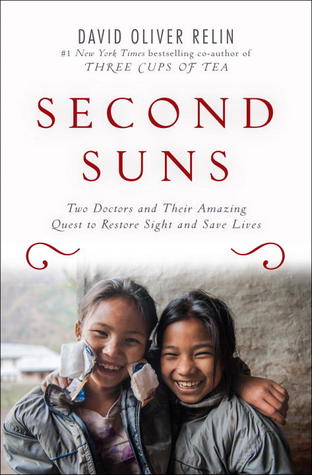
Second Suns by David Oliver Relin

**This review is part of the Amazon Vine Program**

So, despite it being mentioned in this book that the work of the people in it has been featured on television programs and numerous articles, I'd never heard of any of them before this book. And that's really a shame, because what they are doing is so fantastic that it should be a constant topic of conversation everywhere. Hopefully, this book being published can change that.

The author, Relin, is a journalist who has worked on other books (most notably, Three Cups of Tea). In this one, he chronicles the work of Geoffrey Tabin and Sanduk Ruit, two doctors who have teamed together over the past couple of decades to restore sight to the numerous poor blind in the Himalayas, and then on to other countries. Their organization, Himalayan Cataract Project, was founded in 1995 and since then has reached out to Africa, India, Nepal, Bhutan, China, and so many other countries where these men have performed a simple but effective surgery to replace cataracts with a cheaply made clear lens and give back sight to so many people who wouldn't have had the chance otherwise. The book also goes over their early careers and lives and what drew them to this line of work.

The sad passing of Relin in November 2012 is made even more tragic by the amount of work he has placed into this book. Relin takes the backseat but I think even he failed to realize what a difference he made just in writing this book. Sure he wasn't the one performing the surgeries, but by showing the work of these two doctors he's probably gained them tons of support they need that they wouldn't have gotten otherwise. He's brought their cause to light and to a wide audience of people. And that is something admirable and wonderful. Tabin and Ruit, the two doctors featured in this book are also pretty spectacular people as well. While I didn't enjoy reading about Tabin as much as I did Ruit (Ruit's background and personality was more engaging to me) I recognize that they are both experts in their field and obviously filled with generous hearts and ambitions. The way they are presented in this book is very real (Ruit's temper and Tabin's bouncing around) and they aren't perfect by any means. But they're such good people you can forgive them their imperfections. And the people they surround themselves with are all pretty extraordinary as well.

The book is very well done. While I thought the pace could have been better at the beginning of the book, it really engages you in the middle and end and you keep reading to see how many more lives are changed by these doctors. The beginning was mostly about Tabin and his path to becoming a doctor, and seeing as how I'm not a climber, it didn't really resonate with me and hold my interest. In contrast, Ruit's meager roots and how he achieved his success was very inspiring and held my attention. And the work they did together was also just as interesting. For some readers, the descriptions of the eye surgery and occasional mentions of blood might be off-putting, but I think they just show what kind of conditions the doctors are working with and how well they do their jobs despite adversity.

This is definitely a book to read if you enjoy inspiring stories and people who are making a difference in the world. Truly, I hope to hear more and more about the work Tabin and Ruit are doing.

Second Suns
Copyright 2013
407 pages


January 15, 2013

The Springs of Namje by Rajeev Goyal

In my quest to find out if the Peace Corps is right for me, I'm picking up as many books about travel and the Peace Corps itself to read about other's experiences and memories of their time. This was a very good book, and it certainly gave me a lot more history on the Peace Corps than I knew before.

Rajeev Goyal spent two years in the Peace Corps in Nepal. First in one village where he was teaching, but was moved because of upheaval caused by the political tensions in Nepal, and then to Namje, a small town where he also taught. But he did much more than teach in Namje, because it was a village with scarce access to water, Goyal started an initiative to create a pump to pump water from a distant river to the town. His goal was to better the lives of the people there. After his term was over, he moved on to Washington DC, where he became part of an initiative to secure more funding for the Peace Corps. The goal was 450 Million, and the amount asked for equivalent to 5-6 hours of what we spend on our forces in Iraq (figures obtained from the book). That's right, it's in the millions, which when it comes to a government agency, is a small number. He details his struggle at getting this amount and the lobbying he does with lessons learned from his time in the Peace Corps. In the last part of the book, he returns to Namje and Nepal to further work at improving peoples lives through permaculture programs.

Goyal is very generous to those people he gives descriptions of in Nepal. It was easy to see that he really connected with the people in the villages and had great respect for them. He truly wanted to get to know their culture and not change it, but improve living conditions for them. I would say he definitely embodied what the Peace Corps is supposed to be about. When he returns to DC his descriptions are less than flattering of some of the government officials that he has to deal with, but seeing his plight I can kind of agree with him on some of those descriptions. It's hard to face so many walls when you're not asking for much in the grand scheme of things. But even when he's being unflattering I think he is still fair, he never outright insults anyone who turns him down (excepting one representative from TX and I completely agree with him on his thoughts for that guy).

I enjoyed the part of the book that Goyal spent in Nepal. It was descriptive, inspiring, and it really made me see what good a volunteer can do. Not that everything Goyal did was good; he was very realistic in the failures he had as well and what he learned from them. The part where he's running around DC I wasn't as fond of. It's not that it wasn't informative, it certainly was. But it was so rushed and so many names mentioned that I could feel myself getting confused and having to reread paragraphs several times to get an idea of what he was doing. I think slowing it down and expanding on that section could have done a world of good for the book. As it was, I still got the importance of the matter and the disappointment when the requested funding didn't come through for the Peace Corps. One can only hope that in the future that will change. Because it deals with politics as well, there are bound to be some people who are insulted by the ideas presented in this book. I don't think Goyal leans too heavily towards any one party, but I also know when it comes to politics people have strong opinions.

I would have liked to see more on the results of the work he's doing in Nepal now, but it's understandable that it's not included. This book was published and he's still working on it so hopefully another book is still in the making. I would definitely read it if there was one. A splendid book on a Peace Corps member's experience and an inspiring way to look at changing policy in DC, I would definitely recommend this book.

The Springs of Namje
Copyright 2012
210 pages