Showing posts with label disease. Show all posts

March 20, 2014

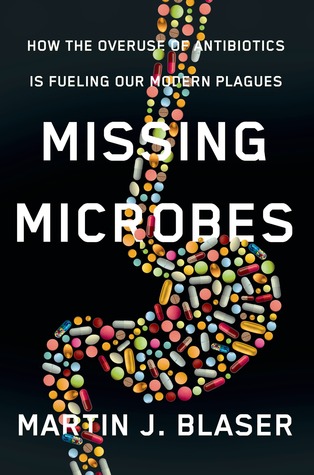
Missing Microbes by Martin J. Blaser

**This review is part of the Amazon Vine Program**

I am not a doctor, nurse, scientist, really any type of person in the medical field.  I'm just a person who thinks that reading about medical issues is interesting.  So it's important for you to know that I'm going into this review without a lot of background and understanding of microbes and biology.  There, the disclaimer is over with.

Missing Microbes is about the microbes in your body and the use of antibiotics.  It explores the concept that perhaps we are doing ourselves a disservice by using so many antibiotics and that some of the microbes previously thought harmful, are in fact an integral part of our body's system and essential to our well being.  Especially explored is H. Pylori that resides in your digestive system and is thought to be a contributor to stomach cancer and ulcers.  Previously eradicated when it was found, new research is showing that it helps protect against other ailments and the destruction of it with antibiotics may not be the best course of action.  There is also a section on birth and the impact that caesarian sections has on the passing of natural microbes from mother to infant.  And several other facts about the bacteria in our bodies.

You can definitely tell the author wanted you to know what he's contributed to the field.  And there's nothing wrong with that although it is a little distracting.  Most of the focus is on the research and several studies are described.  I appreciated the fact that it was written in language that I could understand.  While there were some medical concepts that were a little harder for me, by and large, I understood the descriptions and theories that were presented in this book.  I imagine someone in the medical field would understand it a lot better than I though as they are already comfortable with the terminology and different theories being presented.  I also appreciated that the chapters flowed together smoothly and that while new concepts were introduced in each one, there was a transition that helped guide from talking about one topic to the next.

I learned a lot from this book.  For instance, I never realized that antibiotics are given to farm animals to make them gain weight.  I always figured it was because disease was rampant when you pack animals in together so tight.  The experiments performed on mice showing how antibiotics caused gain of both fat and muscle in early "childhood" was an interesting concept when thinking about the obesity epidemic that the United States and many other countries are facing right now.  However, as said before, I am not a scientist and cannot comment as to the validity of any of these experiments, although it seems (judging from the quite large notes section in the back) that the author did the research and in fact had performed many of the experiments himself.  I believe it's best to look at your information from all sides though and not to take anything from any one paper or book as the absolute truth. 

This book does present some compelling arguments about the use of antibiotics.  Even if you're not worried about super-bugs from overuse, there are several other factors that have only started to be researched.  Anyone interested in bacteria, microbes, and the use of modern medicine would probably find this book a good read.

Missing Microbes
Copyright 2014
259 pages

May 12, 2013

No Time To Lose by Peter Piot

Ebola, AIDS, these are viruses that the mere mention can cause people to become worried and alarmed. While there have been many campaigns to bring awareness to the causes that seek to treat and prevent them, there is still a certain stigma that hangs on to them. Peter Piot, in his work as UNAIDS head, seeks to reducer that stigma and help prevent the spread of AIDS with his work, and wrote this book to accompany those ideas.

Piot started off in medical school with the notion that he wanted to specialize in infectious diseases. And he was told no to bother since they were disappearing from the world. Luckily, he didn't listen, and was on hand to research the first few deadly outbreaks of Ebola and then be a part of the research team for AIDS. His longest work would be with AIDS and he would be a part of several organizations, including USAIDS, throughout his career. The book showed a little of his initial time spent in Zaire working with the Ebola virus and then the larger part of it would be about AIDS and the numerous meetings and people he met to discuss the worldwide effects of the virus.

There are a lot of people in this book. So many that keeping track of them would be absolutely mind boggling and if you didn't know them in real life or hadn't followed them through research papers and other documents, you'd be completely lost. How do I know this? I was completely lost as I didn't know who any of these people were and they were briefly mentioned only to be whisked away again. Piot himself is a clear narrator but while he describes a little bit of his homelife, we only really know his work life, and even that more on the bureaucratic side of things rather than the medical work with actual patients.

This book alternated between being fascinating and boring. The first part, where Piot is working with the Ebola virus, is the interesting part. He details the symptoms, how it was spreading through the population and what they were trying to do to treat it and stop its progression. There are some parts when he is working with AIDS that shares this depth of detail and look into the virus itself. But sadly, the larger portion of this book is devoted to his meetings with people and traveling around trying to defend his organization's actions and other such administrative detail. Unless you like this sort of paperwork type of writing, it is not interesting in the least. While the work they were all doing is very important, it just didn't translate well to the page and I don't think it helped the cause any. Learning about the disease and the people effected by it (personal stories of the people) would have been much more effective.

This is a memoir though and I can't judge it too harshly on that aspect. This is Piot's life and maybe he wrote it to show everything that he did, rather than make it a tool of awareness for infectious disease. Still, when you go into it thinking it will be about something else, it does disappoint in parts.

No Time to Lose
Copyright 2012
379 pages

May 05, 2013

Rabid: A Cultural History of the World's Most Diabolical Virus by Bill Wasik and Monica Murphy

So I'm sure I'm not the only kid who squirted a ton of whipped cream in her mouth and then ran around pretending to be rabid. With a disease that the majority of the population thinks is eradicated, it's easy to make light of what was once thought of as a death sentence. This book explores Rabies and its manifestations throughout history and its current movement in the modern world.

People still die of rabies. And a lot of people don't realize that fact. They think it's gone because of all the vaccinations and other such preventative measures. Even way back in history though, rabies has been a problem. This book covers the whole timeline. It also covers treatments, the development of the vaccine and other methods used for healing. And it gets into the nitty gritty of the disease itself and its symptoms.

A bit focus of this book was on Louis Pasteur. Everybody has heard of Pasteurization but few know that Pasteur also developed the rabies vaccine. I certainly didn't know that until I read this book. While he was the primary person focused on this book, it did go into detail about a lot of beliefs from people on where rabies came from (some very racist in nature), how people chose to heal the disease before the vaccine (very strange stuff), and new advances for helping people in which the disease has already progressed.

This book was engaging and well written. It's one of those books on histories that you actually want to read and find the scientific stuff fascinating instead of tedious. Sure there were a few tedious parts, especially when we got to the werewolf/vampire connection (or maybe that was just my personal preference stepping in), but I did appreciate the light approach the authors took to such a terrible disease. It was approachable and in being approachable it will educate a larger audience. While I do wish there was a little more science involved, the way everything was explained will be largely understandable to most people as it doesn't get too technical. And that's probably why I found it easy to become immersed in the book and even learn a few things.

A very well written book on a fascinating subject. A little gross and disturbing at times, but still very informative.

Rabid
Copyright 2012
236 pages