**This review is part of the Amazon Vine Program**
I am not a doctor, nurse, scientist, really any type of person in the medical field. I'm just a person who thinks that reading about medical issues is interesting. So it's important for you to know that I'm going into this review without a lot of background and understanding of microbes and biology. There, the disclaimer is over with.
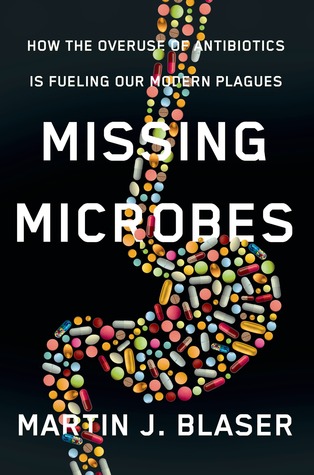
Missing Microbes is about the microbes in your body and the use of antibiotics. It explores the concept that perhaps we are doing ourselves a disservice by using so many antibiotics and that some of the microbes previously thought harmful, are in fact an integral part of our body's system and essential to our well being. Especially explored is H. Pylori that resides in your digestive system and is thought to be a contributor to stomach cancer and ulcers. Previously eradicated when it was found, new research is showing that it helps protect against other ailments and the destruction of it with antibiotics may not be the best course of action. There is also a section on birth and the impact that caesarian sections has on the passing of natural microbes from mother to infant. And several other facts about the bacteria in our bodies.
You can definitely tell the author wanted you to know what he's contributed to the field. And there's nothing wrong with that although it is a little distracting. Most of the focus is on the research and several studies are described. I appreciated the fact that it was written in language that I could understand. While there were some medical concepts that were a little harder for me, by and large, I understood the descriptions and theories that were presented in this book. I imagine someone in the medical field would understand it a lot better than I though as they are already comfortable with the terminology and different theories being presented. I also appreciated that the chapters flowed together smoothly and that while new concepts were introduced in each one, there was a transition that helped guide from talking about one topic to the next.
I learned a lot from this book. For instance, I never realized that antibiotics are given to farm animals to make them gain weight. I always figured it was because disease was rampant when you pack animals in together so tight. The experiments performed on mice showing how antibiotics caused gain of both fat and muscle in early "childhood" was an interesting concept when thinking about the obesity epidemic that the United States and many other countries are facing right now. However, as said before, I am not a scientist and cannot comment as to the validity of any of these experiments, although it seems (judging from the quite large notes section in the back) that the author did the research and in fact had performed many of the experiments himself. I believe it's best to look at your information from all sides though and not to take anything from any one paper or book as the absolute truth.
This book does present some compelling arguments about the use of antibiotics. Even if you're not worried about super-bugs from overuse, there are several other factors that have only started to be researched. Anyone interested in bacteria, microbes, and the use of modern medicine would probably find this book a good read.
Missing Microbes
Copyright 2014
259 pages
Showing posts with label Science. Show all posts
March 20, 2014
November 06, 2013
Their Fate Is Our Fate by Peter Doherty
**This review is part of the Amazon Vine Program**
What do birds have to do with global warming, or swine flu, or other alarming occurrences in our world? A lot actually. Doherty explains just how our avian friends are linked to the health of the world and what we can tell from their reactions to it.
In nineteen chapters, this book covers a myriad of different topics relating to health of birds and health of humans. The use of sentinel birds is explained (ever wonder why there are sometimes chickens on golf courses?), what can be derived from studying embryos, Bird Flu, Bugs, the Hawaiian wipeout, cancer, metal detection, and global warming are just some of the topics covered. There are also extensive notes from the author on different topics and a list of Latin binomials for common bird names. The author also provides further reading, references, and other assorted information.
This is a science heavy book and is not for pleasure reading. Not being experienced in the sciences there were several key medical phrases that I had to do an internet search on just to figure out what the author was talking about. While it is written in relatively easy to understand language, unless you were a science major, there are some things that just can't be put into layman terms. An example sentence from this book would be "Inspired by Rosalind Franklin's X-ray crystallographic pictures (see Chapter 9), which Jim sighted (unbeknown to Rosalind) during the course of a visit to Maurice Wilkins at King's College, London, Watson and Crick built the iconic physical model that shows binary pairings of the deoxyribose nucleic acis (DNA)-adenine-thymine (AT) and guanosine-cytosine (GS)-can assemble as a double helix (pg.123)." This is how the book is written and if that sentence isn't too your liking you probably shouldn't pursue reading it. If it instead piqued your interest, go for it! There's a wealth of knowledge to be had. My only complaint about the writing itself would be the occasional name dropping by the author, but the sporadic additions of humor more than make up for it.
So do you learn about birds in this book? To an extent. It's actually more about diseases and bugs and things that happen to birds rather than learning about any one individual bird itself. Which is good, because it sets out to explain what birds have to do with health and I think it follows that topic quite well. I was surprised and intrigued by all the different topics because I thought it would primarily be about viruses. So the added information on global warming and heavy metals was a bonus. And since it's all presented as science, with references to back it, I was able to feel confident that the information being presented was correct since I am definitely not an expert in the field. I volunteer at a bird rescue and am passingly familiar with some diseases in waterfowl, but found that this book helped me learn more than I ever thought existed. And it made me want to learn more.
A very informative book and while it is high-level, it's something that makes you aspire to learn more, even if you don't quite understand it all on the first read through. I highly recommend this to anyone interested in viruses, birds, and science.
Their Fate Is Our Fate
Copyright 2013
247 pages
What do birds have to do with global warming, or swine flu, or other alarming occurrences in our world? A lot actually. Doherty explains just how our avian friends are linked to the health of the world and what we can tell from their reactions to it.
In nineteen chapters, this book covers a myriad of different topics relating to health of birds and health of humans. The use of sentinel birds is explained (ever wonder why there are sometimes chickens on golf courses?), what can be derived from studying embryos, Bird Flu, Bugs, the Hawaiian wipeout, cancer, metal detection, and global warming are just some of the topics covered. There are also extensive notes from the author on different topics and a list of Latin binomials for common bird names. The author also provides further reading, references, and other assorted information.
This is a science heavy book and is not for pleasure reading. Not being experienced in the sciences there were several key medical phrases that I had to do an internet search on just to figure out what the author was talking about. While it is written in relatively easy to understand language, unless you were a science major, there are some things that just can't be put into layman terms. An example sentence from this book would be "Inspired by Rosalind Franklin's X-ray crystallographic pictures (see Chapter 9), which Jim sighted (unbeknown to Rosalind) during the course of a visit to Maurice Wilkins at King's College, London, Watson and Crick built the iconic physical model that shows binary pairings of the deoxyribose nucleic acis (DNA)-adenine-thymine (AT) and guanosine-cytosine (GS)-can assemble as a double helix (pg.123)." This is how the book is written and if that sentence isn't too your liking you probably shouldn't pursue reading it. If it instead piqued your interest, go for it! There's a wealth of knowledge to be had. My only complaint about the writing itself would be the occasional name dropping by the author, but the sporadic additions of humor more than make up for it.
So do you learn about birds in this book? To an extent. It's actually more about diseases and bugs and things that happen to birds rather than learning about any one individual bird itself. Which is good, because it sets out to explain what birds have to do with health and I think it follows that topic quite well. I was surprised and intrigued by all the different topics because I thought it would primarily be about viruses. So the added information on global warming and heavy metals was a bonus. And since it's all presented as science, with references to back it, I was able to feel confident that the information being presented was correct since I am definitely not an expert in the field. I volunteer at a bird rescue and am passingly familiar with some diseases in waterfowl, but found that this book helped me learn more than I ever thought existed. And it made me want to learn more.
A very informative book and while it is high-level, it's something that makes you aspire to learn more, even if you don't quite understand it all on the first read through. I highly recommend this to anyone interested in viruses, birds, and science.
Their Fate Is Our Fate
Copyright 2013
247 pages
Subscribe to:
Posts (Atom)

