*This review is part of the Amazon Vine Program*
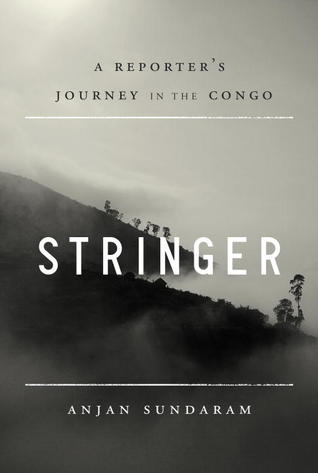
I'm probably in the minority here, but I just couldn't get into this journalist's account of the time he spent in the Congo. As a rule travel books are one of my favored genres, and being as this was not Sundaram's native country I count it as travel in a journalistic capacity.
Sundaram quits pursuing a higher degree in mathematics to become a journalist in the Congo. Why the Congo? A chance meeting with someone in the US enables him to find a place to stay. Plus it's a war torn area is full of news and somewhere a freelancer can find work. So he spends a great deal of time traveling around the Congo and meeting some of the people in it, from the family that he stays with to military leaders and more.
Sundaram doesn't describe himself overly much. We know that he liked math at one point, that he's of Indian descent, and that he didn't mind the hardship of traveling to the Congo. We also know how he feels about people, especially the family that he stays with. But he spends most of his time writing about the people and places that he goes. The family he is honest about describing. Their quirks, flaws, how they can be kind and what happens when they are angry with him. He doesn't hold back at all. And that's the same for all he meets. There are a few unflattering descriptions of people in here. I also thought that while he did describe his interactions, I didn't get a full sense of the personalities of the people he was describing. Especially considering he lived with some of them for awhile.
The writing in this was a bit more flowery than I expected from a journalist writing from a country that has violence in the headlines every day. Very poetic. And I'm sure some people would appreciate it but it made it harder for me to read from a non-fiction perspective. But that was only in parts, in some areas of the book it was very cut and dry and to the point. And I appreciated those sections. It was just hard to mesh the two together for me. I also thought most of the book was spent on him getting to and fro rather than really talking to the people and getting a sense of their daily lives. I know the troubles he went through based on the fact that he was living with them, so there's some through association, but I never really felt as if I knew the complete story behind the family he was staying with or any of the other people he encountered. And the pace felt a bit slow, as if there was stuff going on but the author was removed from it for the majority of the book (although he had a few exciting moments).
I just couldn't get enamored with this book. It has some good parts to it but largely I didn't come away feeling as if I knew anything more about the Congo than I did before.
Stringer
Copyright 2014
265 pages
Showing posts with label Congo. Show all posts
August 04, 2014
February 16, 2013
The Poisonwood Bible by Barbara Kingsolver
When a brash commanding Reverend decides that he needs to be a Missionary, he forces his four children and wife to move out to the Congo with him where he starts preaching at the local people and expecting them to conform to his will. There they must struggle to live in a way they are unaccustomed. to until something tragic happens. And this tragedy will effect each of them in a different way and have them choose different courses for their lives.
Obviously, the father Nathan, is not a sympathetic character in this book. The other characters can't stand him and he is portrayed as a tyrant. But Kingsolver is also careful to throw in the bit about him being injured in the army in there. It's well known that soldiers don't always come back the same person they left as in a war and it's quite a possibility that Nathan was changed in a way. So it leaves it to the reader to see whether or not he actually is a sympathetic character when weighing everything that has happened to him. The mother, Orleanna, I can't say I thought about much one way or the other. She was squashed down by Nathan and I dare say it left her with her own world in her head. Sure she took care of her kids, but there had to be some sort of escape for her and she does fade in and out in the book. The daughters were all distinct although you had to like some more than others. Rachel was too prissy and probably not a favorite of anyone. Adah was strange and hard to connect to, although she got better as the book progressed. Leah was probably the easiest character to become connected to, as she wanted to stand up for what she believed as right. And Ruth May is a young child filled with curiosity.
There is a definitely stance on what Kingsolver believes in this book. Her view on politics and Africa is expressly stated through the actions of her characters. And she sheds a very sympathetic eye on the plight of Africa itself and a not so sympathetic tone with the foreign countries who mingle their affairs with it. And it would appear that she had to have had a bad experience with a reverend or missionary with the true terror she makes Nathan. Although there is a good missionary that appears in the book now and then. The writing itself is what I had trouble with. Kingsolver has a very poetic, descriptive way of writing and that's not the problem. The problem is that there is just way too much of it in this book. It could have easily been half this size and still told a good story. But after awhile I had to put the book down just to take a break because it seemed repetitive. And I enjoyed the latter half with the girls grown up than the previous half that detailed their first year in the Congo. It was just too slow paced for me.
An interesting book and definitely one that you could tell the author did her research on. I don't know much about the politics of the Congo/Zaire itself, but I'd hazard to guess that Kingsolver probably did adequate research there as well. I think I still prefer her non-fiction though and would give this book a solid 3.5 stars.
The Poisonwood Bible
Copyright 1998
543 pages
Subscribe to:
Posts (Atom)
