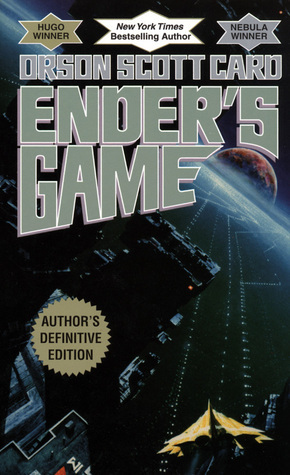
You don't have to like Card to recognize that this is a superb piece of writing. Reading this book has always been powerful to me. You get hooked in from the first page and it's hard to put it down after that. And it's great that it could be read as a standalone, but is part of a series in case you want to continue Ender's story.
Ender is a brilliant child. So much so in fact that he was specifically bred to take part in a program designed for gifted kids. You see, families aren't allowed to have more than two children on future Earth, but Ender's family was given special permission to have him. When at first they remove his monitor though, he think he's flunked out. But time shows that he is about to be groomed to become a commander of the fleet. The buggers are a constant threat in humanity's eyes and the school Ender is sent to, floating in space, is specifically designed to train to neutralize that threat.
Ender is a fantastic character. He is relatable even though he is a substantial amount smarter than your average person. And he has so much going against him and so much expected of him. You're right there with him with his pressures, frustrations, and triumphs. All of the other characters pale beside him, yet they are still complete because they serve a purpose in a way. Especially his brother and sister, who enter into politics and discussion and play their own games. He also has several interesting classmates that play the games with him and they too are incredibly smart. Although some of them can be quite vicious.
From my description you'd probably think this is an action book. But that's just because I can't fully explain the themes and details in such a short time, you'd really need to read the book to get the full experience. It does have action. But it also has political commentary, social morality and lessons about making hard choices in life and the consequences of them. There are gritty details and violence. It's not a pleasant book at all. But it's one that will make you think. And it's so well written that the pace, characters and setting draw you in and don't let you go.
One of my favorite books that I've read and one that I could read over and over. If you've never read the book, or if you've only seen the movie, make sure that you read it, it's well worth it.
Enders Game
Copyright 1985
368 pages
Showing posts with label dystopian. Show all posts
July 02, 2015
July 16, 2013
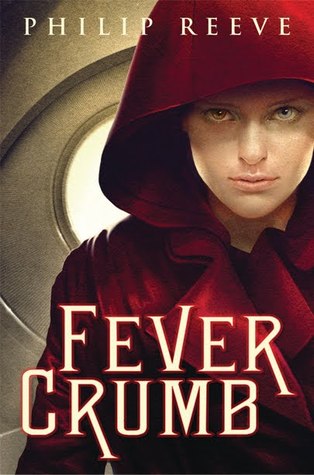
Fever Crumb by Philip Reeve
Ok, so there's a lot of Young Adult Dystopian themed
books out there. But I heard this one was pretty good, so I decided to
give it a try. I was not so impressed and there's a few things I wish I
would have known before reading the book that I know now.
Fever Crumb is the first book in a trilogy. But it's not actually the first book set in this future world. Apparently, there's a whole other series that people recommend you read first in order to understand Fever Crumb's world. But nowhere on the cover or description does it say that, so if you're like me, and start here, you probably won't care much for the series either.
Fever Crumb is a young girl who's been raised by Engineers. This means that she was taught absolute logic and no emotions and to help them with their scientific endeavors. So when she is chosen to go outside their house to help another Engineer do archaeological studies, she is apprehensive, even though that isn't logical. But everything outside is irrational, and because of her unique looks, the local population believes she is a dreaded Scriven (evolved human that was decimated by regular humans), and they would like nothing better than to eliminate her. Add to that memories surfacing that make no sense, Fever is not sure how to adjust in her new world.
Fever is hard to like. Because of all the cold logic she applies she doesn't exactly give you the warm fuzzies or even make you want to care about her. That's ok, she's supposed to be that way, but it makes for an odd protagonist. The man who raised her is also quite cold but I did like the Engineer that took her in to help with research. He may have had selfish motives but he was kind to her. And the Scriven, well we never really know their motives so I don't think they were developed all that well. Sure we understand what they did, just not the why of it.
This book is hurried, with random description and facts thrown in. It was hard to keep track of things. Different technology was thrown in and the author acted like you already understood it and proceed to plow ahead with his story. This might be ok if you had read his other series (and why at the beginning of this review I mentioned that little tidbit) but for anyone just entering in, it does not endear us to Fever's world. Additionally, things happen to fast to be believable and I think the entire book happens over the course of only a few days. As Fever would put it, it just isn't logical. And the whole history of Fever's parents, well that was kind of unbelievable too. The only thing I did like about the writing was the references to popular culture now. Sure it was a little cutsie, but it was amusing.
I can't say I have any desire to continue reading this series or the original one that inspired it. Which is unusual for me, usually I like to finish what I start. But I just couldn't get into this book at all and was relieved when it was over.
Fever Crumb
Copyright 2009
325 pages
Fever Crumb is the first book in a trilogy. But it's not actually the first book set in this future world. Apparently, there's a whole other series that people recommend you read first in order to understand Fever Crumb's world. But nowhere on the cover or description does it say that, so if you're like me, and start here, you probably won't care much for the series either.
Fever Crumb is a young girl who's been raised by Engineers. This means that she was taught absolute logic and no emotions and to help them with their scientific endeavors. So when she is chosen to go outside their house to help another Engineer do archaeological studies, she is apprehensive, even though that isn't logical. But everything outside is irrational, and because of her unique looks, the local population believes she is a dreaded Scriven (evolved human that was decimated by regular humans), and they would like nothing better than to eliminate her. Add to that memories surfacing that make no sense, Fever is not sure how to adjust in her new world.
Fever is hard to like. Because of all the cold logic she applies she doesn't exactly give you the warm fuzzies or even make you want to care about her. That's ok, she's supposed to be that way, but it makes for an odd protagonist. The man who raised her is also quite cold but I did like the Engineer that took her in to help with research. He may have had selfish motives but he was kind to her. And the Scriven, well we never really know their motives so I don't think they were developed all that well. Sure we understand what they did, just not the why of it.
This book is hurried, with random description and facts thrown in. It was hard to keep track of things. Different technology was thrown in and the author acted like you already understood it and proceed to plow ahead with his story. This might be ok if you had read his other series (and why at the beginning of this review I mentioned that little tidbit) but for anyone just entering in, it does not endear us to Fever's world. Additionally, things happen to fast to be believable and I think the entire book happens over the course of only a few days. As Fever would put it, it just isn't logical. And the whole history of Fever's parents, well that was kind of unbelievable too. The only thing I did like about the writing was the references to popular culture now. Sure it was a little cutsie, but it was amusing.
I can't say I have any desire to continue reading this series or the original one that inspired it. Which is unusual for me, usually I like to finish what I start. But I just couldn't get into this book at all and was relieved when it was over.
Fever Crumb
Copyright 2009
325 pages
February 09, 2013
The Windup Girl by Paolo Bacigalupi
This is a very bleak steampunk themed look at a
dystopian world. I like dystopian books normally, but I had a lot of
trouble connecting with this one. It had some good premises, but
unrelatable characters.
In the future the world's wealth is measured in calories. Human bings have messed too far and now food is scarce, there are terminator genes in the food, and several mutated diseases and bacteria abound. There are also new creatures that have been bio-engineered, even people. Among them there is Anderson, a calorie man who is the Thai realm looking for a seed bank and the treasures it could hold within, to return to the big corporation he works for. And then there is Emiko, a windup human who was left for trash when the Japanese business man who owned her decided he didn't want her anymore. She makes her living hiding from the authorities who hate her kind and whoring herself out at a sleazy bar. Together these two will cause upheaval in the city and start a new future that could be more frightening than the one they are already living in.
Emiko, despite her degrading experiences and unique situations I couldn't really get a feel for. I felt pity at times, but that's about it. And I'm not sure if this is the reaction I was supposed to have. After all, she is a wind-up and considered not a real person by society. So maybe that was the author's intent. Anderson was also not that great of a character. I couldn't really feel out his motives. Same with pretty much everyone else in this book. None of them had clear cut thought processes or even inspired sympathy. And finding a glimmer of hope in them was near impossible.
I liked the different ideas presented in this book. Certainly messing with the food system is a scary thing and even eerily similar to some of the experiments companies are doing already. To add in changing the genetic makeup of humans too just seems logical. But as for the actual telling of this story I was confused on so many things. There are just so many unanswered questions on how the world got to the place it did in this book. And then the plot itself is just so rushed around jumping between different characters that it was hard to follow. I was never quite sure who was on who's side, doing what, and why. And I should warn that there are a lot of graphic areas of this book involving sex, violence, murder, rape and sickness. And it is explicit and described in-depth.
Not really too my taste but it had a lot of unique concepts. I'm sure someone who enjoys science and dystopians would enjoy it very much. But I need to relate to the characters if I'm going to enjoy a book.
The Windup Girl
Copyright 2009
359 pages
In the future the world's wealth is measured in calories. Human bings have messed too far and now food is scarce, there are terminator genes in the food, and several mutated diseases and bacteria abound. There are also new creatures that have been bio-engineered, even people. Among them there is Anderson, a calorie man who is the Thai realm looking for a seed bank and the treasures it could hold within, to return to the big corporation he works for. And then there is Emiko, a windup human who was left for trash when the Japanese business man who owned her decided he didn't want her anymore. She makes her living hiding from the authorities who hate her kind and whoring herself out at a sleazy bar. Together these two will cause upheaval in the city and start a new future that could be more frightening than the one they are already living in.
Emiko, despite her degrading experiences and unique situations I couldn't really get a feel for. I felt pity at times, but that's about it. And I'm not sure if this is the reaction I was supposed to have. After all, she is a wind-up and considered not a real person by society. So maybe that was the author's intent. Anderson was also not that great of a character. I couldn't really feel out his motives. Same with pretty much everyone else in this book. None of them had clear cut thought processes or even inspired sympathy. And finding a glimmer of hope in them was near impossible.
I liked the different ideas presented in this book. Certainly messing with the food system is a scary thing and even eerily similar to some of the experiments companies are doing already. To add in changing the genetic makeup of humans too just seems logical. But as for the actual telling of this story I was confused on so many things. There are just so many unanswered questions on how the world got to the place it did in this book. And then the plot itself is just so rushed around jumping between different characters that it was hard to follow. I was never quite sure who was on who's side, doing what, and why. And I should warn that there are a lot of graphic areas of this book involving sex, violence, murder, rape and sickness. And it is explicit and described in-depth.
Not really too my taste but it had a lot of unique concepts. I'm sure someone who enjoys science and dystopians would enjoy it very much. But I need to relate to the characters if I'm going to enjoy a book.
The Windup Girl
Copyright 2009
359 pages
December 26, 2012
The Giver by Lois Lowry
This has been a powerful book for me ever since I first read it in the
sixth grade. Something resonated from then and I return to it over and
over. In fact, I credit it with developing my love of dystopian fiction
in general. And while this book has its flaws, it's so much a part of
my love of books that I simply don't care.
Jonas is an eleven year old living in his community. He has an assigned family unit and the coming December marks his transition to a twelve year old. This is the year that his job assignment happen and he learns his role in the community. However, the unexpected happens when he is chosen to be the new Receiver for his community, a role that is only granted to one person and the previous Receiver is growing old. It isn't until his training though that Jonas learns what this job actually entails. He is the receiver of memory, good and bad, and the only holder of true feelings besides his mentor the Giver, in a world that has chosen sameness over choice and life.
Jonas is pretty compliant. He was designed to be that way from his birth to his training at home. But his experiences with the Giver make him grow and he slowly drifts away from obedience to wanting something better for a community that doesn't want the same thing. The Giver too is a wise but pitiable figure as he has all this knowledge and wisdom and can't really share it with anyone. He has to suffer alone. The other characters are two-dimensional, as they are supposed to be. They have so long been brainwashed and chemically controlled that they are arguably not true humans, but more like robots. And their reactions to each other are so superficial that it's painful to read.
The theme is definitely dystopian. So much so because Jonas does live in the perfect world. No war, no bullies, everyone is polite; but there is no true life. There is no art or music or all the wonderful things that we take for granted in this world. That the quest for perfection and easiness has a high price to pay, and people shouldn't get complacent. And the ending, without giving too much away I do want to comment on it. It gives you a choice, and it's interesting too what people think of the ending and why. I tend to choose the more tragic route. The only thing I could really want more from this book is detail about Jonah's society. There is so much about its past and its everyday workings that I would have loved to understand.
This is definitely a book that will make you think. It will always remain on my shelf and is one that I take with me on long travels. There's a plethora of feelings that come from reading it.
The Giver
Copyright 1993
180 pages
Jonas is an eleven year old living in his community. He has an assigned family unit and the coming December marks his transition to a twelve year old. This is the year that his job assignment happen and he learns his role in the community. However, the unexpected happens when he is chosen to be the new Receiver for his community, a role that is only granted to one person and the previous Receiver is growing old. It isn't until his training though that Jonas learns what this job actually entails. He is the receiver of memory, good and bad, and the only holder of true feelings besides his mentor the Giver, in a world that has chosen sameness over choice and life.
Jonas is pretty compliant. He was designed to be that way from his birth to his training at home. But his experiences with the Giver make him grow and he slowly drifts away from obedience to wanting something better for a community that doesn't want the same thing. The Giver too is a wise but pitiable figure as he has all this knowledge and wisdom and can't really share it with anyone. He has to suffer alone. The other characters are two-dimensional, as they are supposed to be. They have so long been brainwashed and chemically controlled that they are arguably not true humans, but more like robots. And their reactions to each other are so superficial that it's painful to read.
The theme is definitely dystopian. So much so because Jonas does live in the perfect world. No war, no bullies, everyone is polite; but there is no true life. There is no art or music or all the wonderful things that we take for granted in this world. That the quest for perfection and easiness has a high price to pay, and people shouldn't get complacent. And the ending, without giving too much away I do want to comment on it. It gives you a choice, and it's interesting too what people think of the ending and why. I tend to choose the more tragic route. The only thing I could really want more from this book is detail about Jonah's society. There is so much about its past and its everyday workings that I would have loved to understand.
This is definitely a book that will make you think. It will always remain on my shelf and is one that I take with me on long travels. There's a plethora of feelings that come from reading it.
The Giver
Copyright 1993
180 pages
December 02, 2012
Gamers by Thomas K. Carpenter
**This book was received as a Free Advanced Reader's Copy**
Gamers is a book about, well, Gamers. Running with the dystopian theme that is so popular right now, Gamers provides a look at a future where people have shifted over to a very technological reality. I actually enjoyed this book quite a bit, and thought that it offered an interesting approach to the genre. I'd probably give it 3.5 stars because of some things I'd like to see improved, but even so, it had a way of drawing you into the story.
Gabby is a somewhat hacker and gifted student that is preparing for her Final Raid. In Gabby's world, people are ranked by points that will tell whether they get into a job by university or be regulated into the lower class jobs offered to those who don't score high enough. These points are built up by performing regular tasks, playing games at school, and in general succeeding at life. When Gabby's reality is disrupted by a group dubbing themselves the Frags, she learns that her world is not quite what it seems. LifeGame is more real than one could imagine, and the consequences for not scoring high are dire. Especially in the Final Raid, which will determine her and her classmates fates.
Gabby is an ok character. She seems to genuinely care for her friend. Her parents are a different story but we don't see much of them so it doesn't seem to matter if Gabby likes them or not. The Frags as a group were interesting, but we only had a limited time with them so I couldn't really feel connected to them or their plight. I would have liked to know more about this and why Gabby trusted them so much, but I suspect that is reserved for the next book in the series. Gabby's friend also had a limited time in the book but Zaela is a character I connected with. She's an artist, and while that's not highly valued in Gabby's worl, I value it. By contrast, Gabby spends more time with her arch-nemesis, the leader of a group called the Evil Dolls during the final raid. Which don't get me wrong, she was a complex character, I just don't think she should have had more time than Zaela since she's so integral to Gabby's life.
The plot was interesting. Being a past gamer myself I was able to appreciate the Dungeons and Dragons type setting of the last raid. In fact, it may have even brought back some memories for me. That being said, people who aren't gamers might not understand some of the lingo that was used, but I don't think it was greatly devastate their enjoyment of the book. I also didn't really understand the role of the government in the book and why precisely they were fighting a war. There were hints at it all over, but nothing was ever really explained about why such an entity came into the power it had. I also realize this could come in the later books, but it would have been nice to have a little more background to understand Gabby's world together. As it is, it's almost alien. The actual running of the games and the points system was well done. I could see the concept being used efficiently to rank people, and while I may not understand why the games are so important compared to reality type life skills, it made the book interesting to read about the different types of games. I also liked the descriptions of how they could change their rooms and appearances. It just added to the total effect of Gabby's world. The book is descriptive which helps because there is a lot of detail in it. It may end somewhat abruptly, but that just gives a good reason to read the next book in the series.
An interesting take on a dystopian book. I can definitely see myself reading the rest of the books in the series at some point.
Gamers
Copyright 2011
313 pages
Gamers is a book about, well, Gamers. Running with the dystopian theme that is so popular right now, Gamers provides a look at a future where people have shifted over to a very technological reality. I actually enjoyed this book quite a bit, and thought that it offered an interesting approach to the genre. I'd probably give it 3.5 stars because of some things I'd like to see improved, but even so, it had a way of drawing you into the story.
Gabby is a somewhat hacker and gifted student that is preparing for her Final Raid. In Gabby's world, people are ranked by points that will tell whether they get into a job by university or be regulated into the lower class jobs offered to those who don't score high enough. These points are built up by performing regular tasks, playing games at school, and in general succeeding at life. When Gabby's reality is disrupted by a group dubbing themselves the Frags, she learns that her world is not quite what it seems. LifeGame is more real than one could imagine, and the consequences for not scoring high are dire. Especially in the Final Raid, which will determine her and her classmates fates.
Gabby is an ok character. She seems to genuinely care for her friend. Her parents are a different story but we don't see much of them so it doesn't seem to matter if Gabby likes them or not. The Frags as a group were interesting, but we only had a limited time with them so I couldn't really feel connected to them or their plight. I would have liked to know more about this and why Gabby trusted them so much, but I suspect that is reserved for the next book in the series. Gabby's friend also had a limited time in the book but Zaela is a character I connected with. She's an artist, and while that's not highly valued in Gabby's worl, I value it. By contrast, Gabby spends more time with her arch-nemesis, the leader of a group called the Evil Dolls during the final raid. Which don't get me wrong, she was a complex character, I just don't think she should have had more time than Zaela since she's so integral to Gabby's life.
The plot was interesting. Being a past gamer myself I was able to appreciate the Dungeons and Dragons type setting of the last raid. In fact, it may have even brought back some memories for me. That being said, people who aren't gamers might not understand some of the lingo that was used, but I don't think it was greatly devastate their enjoyment of the book. I also didn't really understand the role of the government in the book and why precisely they were fighting a war. There were hints at it all over, but nothing was ever really explained about why such an entity came into the power it had. I also realize this could come in the later books, but it would have been nice to have a little more background to understand Gabby's world together. As it is, it's almost alien. The actual running of the games and the points system was well done. I could see the concept being used efficiently to rank people, and while I may not understand why the games are so important compared to reality type life skills, it made the book interesting to read about the different types of games. I also liked the descriptions of how they could change their rooms and appearances. It just added to the total effect of Gabby's world. The book is descriptive which helps because there is a lot of detail in it. It may end somewhat abruptly, but that just gives a good reason to read the next book in the series.
An interesting take on a dystopian book. I can definitely see myself reading the rest of the books in the series at some point.
Gamers
Copyright 2011
313 pages
October 04, 2012
Animal Farm by George Orwell
I have a mixed relationship with Orwell. At times I
greatly enjoy his works, and at other times (1984 I'm talking about you)
I just can't bring myself to appreciate what are well known as
classics. Luckily, Animal Farm is one of the ones I can appreciate.
Ready for a Revolution, the animals at Manor Farm have had it with the way they have been treated by their human owners. A rebellion breaks out and drives the humans away from the farm and the animals take it over for themselves. They all chip in to do the hard work, but as time passes, certain animals raise themselves as leaders and begin delegating, promising great hopes of tomorrow for the other animals. More and more the perfect society morphs into what they used ot know, with many of them being unaware of it.
These are animals, of course we're going to like them better than a story about people. Who can't be charmed by a horse who wants to work hard or a donkey that just seems a bit gloomy. And I think it's a brilliant way of putting the authors outlook on certain societies and government out there. And the subtle way that it's done is most impressive too. The pigs have brains, there's no denying that and it was interesting to see how Orwell used them to present the change in power amongst the animals. I do think Orwell was a bit unfair to some of the animals though; there should have been a few outstanding cases amongst some creature other than the pigs, just like there are a few outstanding people amongst an unfair government as well.
Obviously this is based on the authors interpretation of communism. But I think the bigger lesson, rather than focusing on any particular government, is that when you have a group of sentient beings, there are going to be some that want more power than others, and no equality can exist in such a dynamic. No utopia will ever be reached because of this trait of humankind either. It just so happens it's represented by animals in this book. And this book isn't very long. It doesn't even reach a hundred pages in my version which is astounding when you think about how much detail and how many ideas are packed into it. And it's presented well without feeling rushed. Although I do have to say, I would have appreciated it being even longer and more ideas being thrown out there. As good as it is, I definitely can see it being even better.
A four and a half star book for me. It's definitely a classic and presents a unique outlook on the power struggles that exist in life.
Animal Farm
Copyright 1945
85 pages
Ready for a Revolution, the animals at Manor Farm have had it with the way they have been treated by their human owners. A rebellion breaks out and drives the humans away from the farm and the animals take it over for themselves. They all chip in to do the hard work, but as time passes, certain animals raise themselves as leaders and begin delegating, promising great hopes of tomorrow for the other animals. More and more the perfect society morphs into what they used ot know, with many of them being unaware of it.
These are animals, of course we're going to like them better than a story about people. Who can't be charmed by a horse who wants to work hard or a donkey that just seems a bit gloomy. And I think it's a brilliant way of putting the authors outlook on certain societies and government out there. And the subtle way that it's done is most impressive too. The pigs have brains, there's no denying that and it was interesting to see how Orwell used them to present the change in power amongst the animals. I do think Orwell was a bit unfair to some of the animals though; there should have been a few outstanding cases amongst some creature other than the pigs, just like there are a few outstanding people amongst an unfair government as well.
Obviously this is based on the authors interpretation of communism. But I think the bigger lesson, rather than focusing on any particular government, is that when you have a group of sentient beings, there are going to be some that want more power than others, and no equality can exist in such a dynamic. No utopia will ever be reached because of this trait of humankind either. It just so happens it's represented by animals in this book. And this book isn't very long. It doesn't even reach a hundred pages in my version which is astounding when you think about how much detail and how many ideas are packed into it. And it's presented well without feeling rushed. Although I do have to say, I would have appreciated it being even longer and more ideas being thrown out there. As good as it is, I definitely can see it being even better.
A four and a half star book for me. It's definitely a classic and presents a unique outlook on the power struggles that exist in life.
Animal Farm
Copyright 1945
85 pages
October 03, 2012
The Death Cure by James Dashner
Wow, how disappointing. Granted I found the series just average anyway,
with the first being the most interesting, but this one just completely
fell flat for me. Still, I'll put my usual disclaimer here, don't
bother reading this one unless you've read the others. This series is
meant to be read in order.
Having defeated the trails by Maze and the barren land known as the Scorch, Thomas and the other survivors are taken to WICKED headquarters. There, they are presented with the opportunity to regain the memories taken from them, but Thomas is suspicious. He hatches a daring plan to escape, but with all the variables that are presented by WICKED, he's never sure he's doing what he's supposed to do, or what they have planned for him. And as the disease known as The Flare keeps spreading, will they even have enough time to come up with a cure.
I didn't really have any compassion for Thomas at all in this book. Nothing he did was logical or made any sort of regular sense. It's like he was just doing things to keep the plot moving without rhyme or reason. And everyone else kind of fell into the backdrop as a result. Characters that were such a big part of the first two novels barely got any time in this one and I think it really lost something because of that. The only other character that really had any time in the book was Brenda, and even she wasn't the character that we were familiar with from the previous book. It might as well have been another person.
The plot also didn't have much of a point. The ending was a cop out in my opinion, but I won't say anything further than that as not to spoil it for anyone. And the variables and trials made no sense whatsoever even after the end of the novel where you would expect it to be explained. It's almost like Dashner didn't think that part out and had to throw something together to at least make an ending. And it doesn't work. There is a lot of violence in this book too, and while some of it is appropriate, some of it just seemed meaningless, like filler. If I have to summarize everything about this book, it just didn't provide satisfying answers.
Not a good ending to the series and as a result not a series I would particularly recommend. There are better dystopians out there.
The Death Cure
Copyright 2011
324 pages
Having defeated the trails by Maze and the barren land known as the Scorch, Thomas and the other survivors are taken to WICKED headquarters. There, they are presented with the opportunity to regain the memories taken from them, but Thomas is suspicious. He hatches a daring plan to escape, but with all the variables that are presented by WICKED, he's never sure he's doing what he's supposed to do, or what they have planned for him. And as the disease known as The Flare keeps spreading, will they even have enough time to come up with a cure.
I didn't really have any compassion for Thomas at all in this book. Nothing he did was logical or made any sort of regular sense. It's like he was just doing things to keep the plot moving without rhyme or reason. And everyone else kind of fell into the backdrop as a result. Characters that were such a big part of the first two novels barely got any time in this one and I think it really lost something because of that. The only other character that really had any time in the book was Brenda, and even she wasn't the character that we were familiar with from the previous book. It might as well have been another person.
The plot also didn't have much of a point. The ending was a cop out in my opinion, but I won't say anything further than that as not to spoil it for anyone. And the variables and trials made no sense whatsoever even after the end of the novel where you would expect it to be explained. It's almost like Dashner didn't think that part out and had to throw something together to at least make an ending. And it doesn't work. There is a lot of violence in this book too, and while some of it is appropriate, some of it just seemed meaningless, like filler. If I have to summarize everything about this book, it just didn't provide satisfying answers.
Not a good ending to the series and as a result not a series I would particularly recommend. There are better dystopians out there.
The Death Cure
Copyright 2011
324 pages
October 02, 2012
The Scorch Trials by James Dashner
The Scorch Trials is the second book in the Maze
Runner series by James Dashner. I always recommend starting at the
beginning of a series, and this one is no different, but to be honest, I
had a hard time following this one even having read the first.
After escaping the maze, Thomas and Co. only think they are somewhere safe when all of a sudden, they find themselves in the middle of another test. This time they're turned loose in the Scorch, a hot dry area with sickened "zombies" roaming about. They all have the sickness too, and are told that in order to get the cure, they must reach a place one hundred miles away in just a few short weeks. From there it's fighting death and facing betrayal and Thomas has to make several decisions that aren't easy. But the need to survive is strong in him.
Thomas isn't that great of a character. I don't connect with him at all and it seems like things happen a little too easy and coincidental for him. With everything being a test it's hard to say that that isn't on purpose, but without revealing enough of those tests, as a reader I simply don't care. Some of the characters I did really like, like Minho, take a back seat in this book too and it's always about Thomas, which gets a little wearisome since I don't care for him. Teresa too doesn't improve with this book and in an odd sense, she and Thomas really are perfect for each other, because I rate them at the same level of interesting. The new girl, Brenda, at least has some fire and real human emotion in her.
The plot moves along very quickly but even so it was filled with violence and different descriptions that would make your eyes bug out. This isn't necessarily a bad thing, but it just seemed like filler to me. Yes this is a middle book, but it can have a decent plot of its own without merely being words to connect two other books. I also wonder at how some of the things in this book are written, we have description but it isn't really complete. I can't picture the places they are talking about very well or even the people. Thomas himself is supposed to be sixteen, but I always get the impression that he's younger than that based on his description. It just is hard to form an idea in your head on what the world is like with the little information given.
This is just average reading for a dystopian novel. It has an interesting idea but there's so many loose ends and the fact that this book was filler does it no favors. I want to know what happens so of course I'll read the last book, but I can only hope it improves on the flaws of the first two.
The Scorch Trials
Copyright 2010
360 pages
After escaping the maze, Thomas and Co. only think they are somewhere safe when all of a sudden, they find themselves in the middle of another test. This time they're turned loose in the Scorch, a hot dry area with sickened "zombies" roaming about. They all have the sickness too, and are told that in order to get the cure, they must reach a place one hundred miles away in just a few short weeks. From there it's fighting death and facing betrayal and Thomas has to make several decisions that aren't easy. But the need to survive is strong in him.
Thomas isn't that great of a character. I don't connect with him at all and it seems like things happen a little too easy and coincidental for him. With everything being a test it's hard to say that that isn't on purpose, but without revealing enough of those tests, as a reader I simply don't care. Some of the characters I did really like, like Minho, take a back seat in this book too and it's always about Thomas, which gets a little wearisome since I don't care for him. Teresa too doesn't improve with this book and in an odd sense, she and Thomas really are perfect for each other, because I rate them at the same level of interesting. The new girl, Brenda, at least has some fire and real human emotion in her.
The plot moves along very quickly but even so it was filled with violence and different descriptions that would make your eyes bug out. This isn't necessarily a bad thing, but it just seemed like filler to me. Yes this is a middle book, but it can have a decent plot of its own without merely being words to connect two other books. I also wonder at how some of the things in this book are written, we have description but it isn't really complete. I can't picture the places they are talking about very well or even the people. Thomas himself is supposed to be sixteen, but I always get the impression that he's younger than that based on his description. It just is hard to form an idea in your head on what the world is like with the little information given.
This is just average reading for a dystopian novel. It has an interesting idea but there's so many loose ends and the fact that this book was filler does it no favors. I want to know what happens so of course I'll read the last book, but I can only hope it improves on the flaws of the first two.
The Scorch Trials
Copyright 2010
360 pages
October 01, 2012
The Maze Runner by James Dashner
The Maze Runner was a book that came recommended to
those who like dystopian novels and in general the sort of fiction
that's being put out for teens right now. As most of those can be hit
or miss I approached it with trepidation. The results; I thought it was
ok, but not nearly as good as it was hyped up to be.
Thomas wakes up in a dark box which rises to the surface of a hostile world. Here there are just boys who are doing their best to survive, and he's the newbie who's entered their world. Aside from once a month supply deliveries, they are on their own. The have their own little place to sleep and grow food, but outside those walls is a maze none of them have been able to solve. And if they are unable to solve it, they don't get to go home. The special task of handling this running of a maze is given to the select few, known as Runners. And you would think solving a maze would be easy when there's so much time to do it; but dark things come out at night, and the maze is always changing.
I couldn't really connect with any of the characters in this book. There were some stand out ones, sure, but the large majority of them just didn't spark that connection. Especially Thomas, he's our main character and while I can appreciate his intelligence and fortitude, I don't particularly like him and am really sort of ambivalent to him. The same goes for the only girl in the story, Teresa, who was just a little too perfect. The only character I really did like was a boy named Minho, who had a bit of spunk to him and was a runner. There were a couple of "bad guys" I suppose and the author made it easy to dislike them, so that was saying something at least.
The plot was ok. I liked the maze concept and why they were in there and I thought the ending had a nice twist. But the pacing was a little rushed and everything seemed to happy a little too easy for the main protagonist. I realize that it was somewhat supposed to be, but it lessened the sense of excitement and struggle that you wanted to perceive in this book. Being dystopian, it just should have been harder to do what they were doing. I did like the beginning though, as Thomas is dropped into this world it has a whole different lexicon that he has trouble understanding at first. And it's the same for the reader, but as he starts to understand, we begin to understand the different slang terms being used, and that made the book kind of realistic.
It's not a bad book, just not up to par with some of the other dystopian series out there. I will of course read the rest of the trilogy though and hope that it improves with each book.
The Maze Runner
Copyright 2009
374 pages
Thomas wakes up in a dark box which rises to the surface of a hostile world. Here there are just boys who are doing their best to survive, and he's the newbie who's entered their world. Aside from once a month supply deliveries, they are on their own. The have their own little place to sleep and grow food, but outside those walls is a maze none of them have been able to solve. And if they are unable to solve it, they don't get to go home. The special task of handling this running of a maze is given to the select few, known as Runners. And you would think solving a maze would be easy when there's so much time to do it; but dark things come out at night, and the maze is always changing.
I couldn't really connect with any of the characters in this book. There were some stand out ones, sure, but the large majority of them just didn't spark that connection. Especially Thomas, he's our main character and while I can appreciate his intelligence and fortitude, I don't particularly like him and am really sort of ambivalent to him. The same goes for the only girl in the story, Teresa, who was just a little too perfect. The only character I really did like was a boy named Minho, who had a bit of spunk to him and was a runner. There were a couple of "bad guys" I suppose and the author made it easy to dislike them, so that was saying something at least.
The plot was ok. I liked the maze concept and why they were in there and I thought the ending had a nice twist. But the pacing was a little rushed and everything seemed to happy a little too easy for the main protagonist. I realize that it was somewhat supposed to be, but it lessened the sense of excitement and struggle that you wanted to perceive in this book. Being dystopian, it just should have been harder to do what they were doing. I did like the beginning though, as Thomas is dropped into this world it has a whole different lexicon that he has trouble understanding at first. And it's the same for the reader, but as he starts to understand, we begin to understand the different slang terms being used, and that made the book kind of realistic.
It's not a bad book, just not up to par with some of the other dystopian series out there. I will of course read the rest of the trilogy though and hope that it improves with each book.
The Maze Runner
Copyright 2009
374 pages
September 03, 2012
Crewel by Gennifer Albin
**This review is part of the Amazon Vine program**
I absolutely loved this book. I found it innovative and unlike anything else I had read before. And it was dystopian, which is one of my favorite genres. It definitely made me glad I picked a book out because of its cover when I don't normally do that.
Adelice lives in a world that is controlled by Spinsters. Women who can weave the looms that run the world. And the Spinsters of course are controlled by the guild. From the food that is given to whether or not daughters or sons are born to a family, everything is controlled in her world. Her parents hope that she won't become a Spinster, and she never really realizes why until she is called into service. It's a cutthroat occupation and far more devious than she ever imagined. And her abilities are beyond the normal set for girls, making her world a little more treacherous as a result.
Adelice is a very strong character. She's smart, but sometimes can't control what she says and I can totally relate to having a lack of filter. She just won't take anything from anybody if she can help it. And the situation she is put into is certainly an interesting one and quite dangerous to her if she doesn't play the game right. With all the antagonists in this story it's also hard to pick a favorite one. They all play their role very well and it's very hard to tell who's who and on what side. And if they really think what they're doing is for the good of all or just in it for themselves. I did like Adelice's male companions as well. They were each very unique and relevant to the story.
The idea of a world being controlled by weavers is interesting. It shows some roots in mythology but takes it to a whole other level. And the detail of that level is astounding. Albin did a very good job world building and describing how the weaving takes place. I could almost see it happening in my head. But her world is also very cruel, as they must be in a dystopian novel and it definitely makes you root for the main character to overcome the odds. The only think I was really disappointed in was the abrupt ending. Everything just rushed a little too fast for me.
But I will definitely look forward to the sequel of this book. I have to know what happens and I care about the characters and want to know what will become of them. A very intriguing story to be sure.
Crewel
Copyright 2012
357 pages
I absolutely loved this book. I found it innovative and unlike anything else I had read before. And it was dystopian, which is one of my favorite genres. It definitely made me glad I picked a book out because of its cover when I don't normally do that.
Adelice lives in a world that is controlled by Spinsters. Women who can weave the looms that run the world. And the Spinsters of course are controlled by the guild. From the food that is given to whether or not daughters or sons are born to a family, everything is controlled in her world. Her parents hope that she won't become a Spinster, and she never really realizes why until she is called into service. It's a cutthroat occupation and far more devious than she ever imagined. And her abilities are beyond the normal set for girls, making her world a little more treacherous as a result.
Adelice is a very strong character. She's smart, but sometimes can't control what she says and I can totally relate to having a lack of filter. She just won't take anything from anybody if she can help it. And the situation she is put into is certainly an interesting one and quite dangerous to her if she doesn't play the game right. With all the antagonists in this story it's also hard to pick a favorite one. They all play their role very well and it's very hard to tell who's who and on what side. And if they really think what they're doing is for the good of all or just in it for themselves. I did like Adelice's male companions as well. They were each very unique and relevant to the story.
The idea of a world being controlled by weavers is interesting. It shows some roots in mythology but takes it to a whole other level. And the detail of that level is astounding. Albin did a very good job world building and describing how the weaving takes place. I could almost see it happening in my head. But her world is also very cruel, as they must be in a dystopian novel and it definitely makes you root for the main character to overcome the odds. The only think I was really disappointed in was the abrupt ending. Everything just rushed a little too fast for me.
But I will definitely look forward to the sequel of this book. I have to know what happens and I care about the characters and want to know what will become of them. A very intriguing story to be sure.
Crewel
Copyright 2012
357 pages
August 23, 2012
Yield by Bryan K. Johnson
**This book was received as a free advanced review copy**
I wasn't sure what to make of this book at first. It started slow, wasn't my normal reading style, but as I continued it I felt myself being drawn more and more into the story. Enough that I definitely would like to read the other books that will come in the series.
Yield is a futuristic take on America and what could happen to its citizens in a tragic event. More specifically, it offers up a third world war kind of situation, with all the modern elements that we take for granted today that weren't in the first world wars. There are three main sets of characters that the storyline revolves around. The first and foremost being a group of people who were on a plane when bombs struck nearby Seattle. The survivors band together and try to make their way back to Portland, where most of them have family. One of these characters, a fireman named Devin, has a family in Portland around which the book also tells a little of the story and how they are coping in a city not hit by the bombs. And the third group, are media news people, who were in Seattle at the time of the attack and want desperately to broadcast what's happening there to the rest of America. All of these people have to fight for survival in a now hostile Seattle with several unsavory people roaming the streets with them. Food, shelter, and protection are a must as well and not easily come by.
I like most of the characters in this book. Especially those with Devin in the primary group. It was easy to see that they were given the most attention and detail by the author. In contrast, while the other groups were ok, I just didn't feel as interested in them and their storyline and actually would have preferred that the book not be split into sections and stuck with the main group. But they did provide some kind of background to some of the characters. Devin especially was interesting, and while he had some problems, he seemed to be an all around good guy. The rest of the group followed suit being decent individuals. There aren't really bad guys per say in this book. At least not reoccurring ones. There are the people that dropped the bombs, but they're still mostly a mystery as far as motivation and specifics. There are the wild people roaming the streets, who don't stay in the book long and there's also just everyday people, who by being themselves offer conflict. So it's a varied group but with no one for certain that we can hate as an antagonist. Which since we're rooting for Devin and the gang anyway, it doesn't seem to matter what adversaries they face.
I enjoyed the plot and premise of this book. The "what if" kind of scenarios are always intriguing, although I genuinely hope this is nothing like what our future could turn out to be. That being said, I did have some issues with the way the book was written. I almost lost interest in the first part of the book because there was just too much build up. It got tedious and I wasn't really enjoying myself, luckily that switched as I stuck it through and the book got very interesting. Almost to the point of hard to put down interesting. I also wasn't a big fan of the use of present tense. There's very few books that can get away with using present tense successfully and while this one was readable, I'm not sure it was the best choice. It can make things seem more urgent, but it can also make books read somewhat stilted as well. There is violence in this book, cussing, and other things that some people could find offensive, but hey, it's a book about violence, you kind of have to expect that. If that's not your thing, you shouldn't be reading it. I happened to think it made it more realistic.
I'll definitely look out for the next in the series (although I'll be secretly hoping it switches to past tense). Should be an interesting read and I'm looking forward to what happens to the characters.
Yield
Copyright 2012
425 pages
I wasn't sure what to make of this book at first. It started slow, wasn't my normal reading style, but as I continued it I felt myself being drawn more and more into the story. Enough that I definitely would like to read the other books that will come in the series.
Yield is a futuristic take on America and what could happen to its citizens in a tragic event. More specifically, it offers up a third world war kind of situation, with all the modern elements that we take for granted today that weren't in the first world wars. There are three main sets of characters that the storyline revolves around. The first and foremost being a group of people who were on a plane when bombs struck nearby Seattle. The survivors band together and try to make their way back to Portland, where most of them have family. One of these characters, a fireman named Devin, has a family in Portland around which the book also tells a little of the story and how they are coping in a city not hit by the bombs. And the third group, are media news people, who were in Seattle at the time of the attack and want desperately to broadcast what's happening there to the rest of America. All of these people have to fight for survival in a now hostile Seattle with several unsavory people roaming the streets with them. Food, shelter, and protection are a must as well and not easily come by.
I like most of the characters in this book. Especially those with Devin in the primary group. It was easy to see that they were given the most attention and detail by the author. In contrast, while the other groups were ok, I just didn't feel as interested in them and their storyline and actually would have preferred that the book not be split into sections and stuck with the main group. But they did provide some kind of background to some of the characters. Devin especially was interesting, and while he had some problems, he seemed to be an all around good guy. The rest of the group followed suit being decent individuals. There aren't really bad guys per say in this book. At least not reoccurring ones. There are the people that dropped the bombs, but they're still mostly a mystery as far as motivation and specifics. There are the wild people roaming the streets, who don't stay in the book long and there's also just everyday people, who by being themselves offer conflict. So it's a varied group but with no one for certain that we can hate as an antagonist. Which since we're rooting for Devin and the gang anyway, it doesn't seem to matter what adversaries they face.
I enjoyed the plot and premise of this book. The "what if" kind of scenarios are always intriguing, although I genuinely hope this is nothing like what our future could turn out to be. That being said, I did have some issues with the way the book was written. I almost lost interest in the first part of the book because there was just too much build up. It got tedious and I wasn't really enjoying myself, luckily that switched as I stuck it through and the book got very interesting. Almost to the point of hard to put down interesting. I also wasn't a big fan of the use of present tense. There's very few books that can get away with using present tense successfully and while this one was readable, I'm not sure it was the best choice. It can make things seem more urgent, but it can also make books read somewhat stilted as well. There is violence in this book, cussing, and other things that some people could find offensive, but hey, it's a book about violence, you kind of have to expect that. If that's not your thing, you shouldn't be reading it. I happened to think it made it more realistic.
I'll definitely look out for the next in the series (although I'll be secretly hoping it switches to past tense). Should be an interesting read and I'm looking forward to what happens to the characters.
Yield
Copyright 2012
425 pages
July 17, 2012
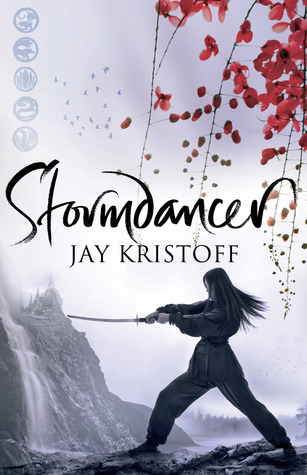
Stormdancer by Jay Kristoff
*This review is part of the Amazon Vine program*
What's not to like about a dystopian, steampunk, book in feudal Japan? Well, really there's not a whole lot in this book that isn't good, but for some reason, I just had a hard time getting into it. As a side note, my cat is named Arashi, so I got a little smile out of the name used for the griffin in this book.
Yukiko is the daughter of the great hunter for the Shogun (ruler) of their country. In a land filled with toxins produced by the blood lotus, a flower that is a hallucinogen and can be used to make fuel, things have slowly gone from bad to worse. Now, the Shogun has decided he wants an Arashitora (griffin), the only problem is, no one has seen any for hundreds of years. But Yukiko and her father have no choice, they must go hunting for one or risk their lives, and when they do find one, capturing it isn't going to be easy. Through a series of events the griffin and Yukiko must rely on each other and learn more about what kind of world they want to live in.
Yukiko is a good character. She's strong, brave, and manages to get herself into quite a bit of trouble; enough to keep it interesting anyway. But she can also be incredibly naive and wishy-washy. Buruu is a much cooler character. He's a griffin, so that's a little strange, but I really liked his personality. Even the way the author had him "talk" in the book was kind of neat and seemed completely fitting for how a Griffin should speak. I did think the bad guy, while supposed to be menacing, just didn't really make my blood run cold. Some of the side characters did a better job of that because while he talked the talk, he never really did too much where you could read about it. We were just told after of his actions.
The book's pace is kind of slow through the first couple chapters. There's a lot of world building, and while that's important, it made it hard for me to keep with it. Finally, I made myself sit down and really start reading the book and it started getting more and more interesting and the pace improved to where I had to finish it, I couldn't set it down. So at least it ended on a good note. The premise is very unique. While there's all sorts of elements used from other books, they're an odd mix that somehow the author uses very well. I liked how there were fantasy creatures mixed in with steampunk elements. It was unusual. The language was a little strange, not something I'd expect to read for a society set in Japan, it was more American, and slang. And there was even some cursing. I guess I just expected more formal language.
An interesting book, and worth sticking through the slow beginning for. I look forward to the next in the series.
Stormdancer
Copyright 2012
324 pages
What's not to like about a dystopian, steampunk, book in feudal Japan? Well, really there's not a whole lot in this book that isn't good, but for some reason, I just had a hard time getting into it. As a side note, my cat is named Arashi, so I got a little smile out of the name used for the griffin in this book.
Yukiko is the daughter of the great hunter for the Shogun (ruler) of their country. In a land filled with toxins produced by the blood lotus, a flower that is a hallucinogen and can be used to make fuel, things have slowly gone from bad to worse. Now, the Shogun has decided he wants an Arashitora (griffin), the only problem is, no one has seen any for hundreds of years. But Yukiko and her father have no choice, they must go hunting for one or risk their lives, and when they do find one, capturing it isn't going to be easy. Through a series of events the griffin and Yukiko must rely on each other and learn more about what kind of world they want to live in.
Yukiko is a good character. She's strong, brave, and manages to get herself into quite a bit of trouble; enough to keep it interesting anyway. But she can also be incredibly naive and wishy-washy. Buruu is a much cooler character. He's a griffin, so that's a little strange, but I really liked his personality. Even the way the author had him "talk" in the book was kind of neat and seemed completely fitting for how a Griffin should speak. I did think the bad guy, while supposed to be menacing, just didn't really make my blood run cold. Some of the side characters did a better job of that because while he talked the talk, he never really did too much where you could read about it. We were just told after of his actions.
The book's pace is kind of slow through the first couple chapters. There's a lot of world building, and while that's important, it made it hard for me to keep with it. Finally, I made myself sit down and really start reading the book and it started getting more and more interesting and the pace improved to where I had to finish it, I couldn't set it down. So at least it ended on a good note. The premise is very unique. While there's all sorts of elements used from other books, they're an odd mix that somehow the author uses very well. I liked how there were fantasy creatures mixed in with steampunk elements. It was unusual. The language was a little strange, not something I'd expect to read for a society set in Japan, it was more American, and slang. And there was even some cursing. I guess I just expected more formal language.
An interesting book, and worth sticking through the slow beginning for. I look forward to the next in the series.
Stormdancer
Copyright 2012
324 pages
June 14, 2012
The Transall Saga by Gary Paulsen
Paulsen should write more dystopians. He's good at
them. Even though they're geared towards a younger market, I do think
his books appeal to all ages.
The Transall Saga finds Mark, a teenager on his first camping trip by himself. He's not out long when a brilliant tube of light transports him to what he thinks is another world. Here things are just off, animals are different, vegetation is different, and the people while similar, aren't like they were where he came from. But after facing numerous hardships with these people, he grows to like them. But a man called Merkon isn't too keen on Mark, and isn't afraid to do everything in his power to rid the world of Transall of Mark.
Mark's a pretty cool guy. We only get a little bit of description about him, but it's enough. I get a very good sense of what he looks like and his actions speak loudly enough for him. He's a pretty good guy and cares about others. The rest of the characters weren't nearly as fleshed out as Mark, but they certainly add to the story. Megaan especially was great as she was a strong person and had quite a few flaws making her real. I think the other girl, Leeta, got kind of left in the dust when compared to Megaan, but we can't all be special.
The plot is dystopian, which I love. Anywhere where the main character is sent somewhere where things aren't quite right and people are living primitively is interesting. And the bad guy in the Merkon was pretty menacing. I do think that the ending was a bit rushed, and I would have liked to see the book longer with more detail, but for a young adult/children's book, this is probably pretty good for the detail.
Definitely one of the better ones by Paulsen in my opinion. I've read some stinkers from him, but this one is not one of them.
The Transall Saga
Copyright 1998
248 pages
The Transall Saga finds Mark, a teenager on his first camping trip by himself. He's not out long when a brilliant tube of light transports him to what he thinks is another world. Here things are just off, animals are different, vegetation is different, and the people while similar, aren't like they were where he came from. But after facing numerous hardships with these people, he grows to like them. But a man called Merkon isn't too keen on Mark, and isn't afraid to do everything in his power to rid the world of Transall of Mark.
Mark's a pretty cool guy. We only get a little bit of description about him, but it's enough. I get a very good sense of what he looks like and his actions speak loudly enough for him. He's a pretty good guy and cares about others. The rest of the characters weren't nearly as fleshed out as Mark, but they certainly add to the story. Megaan especially was great as she was a strong person and had quite a few flaws making her real. I think the other girl, Leeta, got kind of left in the dust when compared to Megaan, but we can't all be special.
The plot is dystopian, which I love. Anywhere where the main character is sent somewhere where things aren't quite right and people are living primitively is interesting. And the bad guy in the Merkon was pretty menacing. I do think that the ending was a bit rushed, and I would have liked to see the book longer with more detail, but for a young adult/children's book, this is probably pretty good for the detail.
Definitely one of the better ones by Paulsen in my opinion. I've read some stinkers from him, but this one is not one of them.
The Transall Saga
Copyright 1998
248 pages
May 29, 2012
Crashing Eden by Michael Sussman
*This book was received as a Free Advanced Reader's Copy*
This book was not at all what I expected it to be. I expected Dystopian, the title and cover seemed to point to that, but while I might consider it slightly dystopian, I actually considered it more theology and fantasy and a little bit of other stuff thrown in.
Joss has been a troublemaker most his life. After the death of his brother, things just went a little crazier for him and after spending some time in Juvie, he gets to return home to his parents and his sister. But then after a bike accident, he begins to hear strange things, and it completely changes his outlook on life. Instead of the anger he was feeling, it melts into peace and understanding, and with the help of some chance encounters, he also discovers that the sound is a part of something more. It unlocks Eden, sends those who hear it crashing into the forbidden and as it catches on, the one who threw humans out of Eden begins to notice, and is not happy at all.
I like Joss. Despite what a terrible person he seems to have been you can't help but like him. He is just that relate-able as a character. I even liked his little sister, she was charming in a way although at times much wiser beyond her six years. That being said his mother was just way out there. I'm sure there's really people out there like that, but I just couldn't like her at all. And I found Alessa, a girl he hurt, a bit unbelievable too. It seems to me that forgiveness is a hard thing to reach, and she reached it so easily. So maybe she's just a better person than me, who knows.
The plot was very interesting. I liked the theology thrown in, although if you are a very strict Christian, this may not be the book for you. It has a little wider mind of how the Universe works. And I like that version of the Universe, it is a unique take on it. I also enjoyed how the characters discovered some of the ideas in this book on how the world works. I also enjoyed the way the book was written and how even though it seemed geared towards young adults, adults could enjoy the themes and writing style as well. My biggest complaint would probably be that the ending seemed too easy. The book meandered through the first half and then rushed through the second and it was almost as if the author was in a hurry to finish up the book and didn't expand and create a more involved ending. It was still a good ending, don't get me wrong, but maybe not as fantastic as it could have been.
Definitely interesting and I would probably look for more from this author. Unique concepts made this book a worthwhile read.
Crashing Eden
Copyright 2012
214 pages
This book was not at all what I expected it to be. I expected Dystopian, the title and cover seemed to point to that, but while I might consider it slightly dystopian, I actually considered it more theology and fantasy and a little bit of other stuff thrown in.
Joss has been a troublemaker most his life. After the death of his brother, things just went a little crazier for him and after spending some time in Juvie, he gets to return home to his parents and his sister. But then after a bike accident, he begins to hear strange things, and it completely changes his outlook on life. Instead of the anger he was feeling, it melts into peace and understanding, and with the help of some chance encounters, he also discovers that the sound is a part of something more. It unlocks Eden, sends those who hear it crashing into the forbidden and as it catches on, the one who threw humans out of Eden begins to notice, and is not happy at all.
I like Joss. Despite what a terrible person he seems to have been you can't help but like him. He is just that relate-able as a character. I even liked his little sister, she was charming in a way although at times much wiser beyond her six years. That being said his mother was just way out there. I'm sure there's really people out there like that, but I just couldn't like her at all. And I found Alessa, a girl he hurt, a bit unbelievable too. It seems to me that forgiveness is a hard thing to reach, and she reached it so easily. So maybe she's just a better person than me, who knows.
The plot was very interesting. I liked the theology thrown in, although if you are a very strict Christian, this may not be the book for you. It has a little wider mind of how the Universe works. And I like that version of the Universe, it is a unique take on it. I also enjoyed how the characters discovered some of the ideas in this book on how the world works. I also enjoyed the way the book was written and how even though it seemed geared towards young adults, adults could enjoy the themes and writing style as well. My biggest complaint would probably be that the ending seemed too easy. The book meandered through the first half and then rushed through the second and it was almost as if the author was in a hurry to finish up the book and didn't expand and create a more involved ending. It was still a good ending, don't get me wrong, but maybe not as fantastic as it could have been.
Definitely interesting and I would probably look for more from this author. Unique concepts made this book a worthwhile read.
Crashing Eden
Copyright 2012
214 pages
April 24, 2012
Partials by Dan Wells
**This review is part of the Amazon Vine program**
I waffled in between liking this book and not liking it. Finally I arrived at giving it 3.5 stars. There were a lot of neat aspects to this dystopian novel, but ultimately, it was very predictable.
Kira lives in a world that has been ultimately destroyed by the partials. At last count, there are maybe forty-thousand humans left in the world that they know of, and they're living on Long Island. As a medic, Kira has been trying to find a cure for the RM disease that wiped out most of the population, and is now killing their children. The youngest person is fourteen as they have not found a way to reproduce, despite making it mandatory in women of young age. So she decides she needs to capture a Partial to study the biologically engineered creature. She just may learn some truths about her world that she isn't ready for in the process.
I like Kira. She's strong, makes mistakes, and isn't really afraid to say what she thinks. That being said, she is a little too perfect at times. And I completely guessed where her character was going to go by the end of the novel. My only thought was that I couldn't figure out how it made sense. But you'll see once you get to that point, I won't spoil it for you. Her boyfriend is pretty cool as well. He's got a sense of humor and adds some levity to the book. There are numerous other characters, but they aren't as focused on as Kira, and while it drives me nuts that we don't get their back stories sometimes, I'm hoping the continuing series will rectify that.
The writing, as said before, is predictable. I had an idea of what was going to happen long before it ever actually happened in the book. It also drags quite a bit for the first half. I got tired of the detail and just wanted something to happen, and then I got my wish and everything started happening at once and the second half went too quickly. I think some balance would have been nice. The idea was fairly innovative. With all the dystopian novels coming out it's hard to be wholly original. But I think Wells has written something here that's worth reading if you like that genre of books. It is considered young adult and while there's nothing extreme in here, it does reference to sex and other more mature themes.
I will probably continue reading this series. I like the concept and if the author balances the other books a little better they'll be worth reading. This one too was enjoyable when it came down to it as well.
Partials
Copyright 2012
472 pages
I waffled in between liking this book and not liking it. Finally I arrived at giving it 3.5 stars. There were a lot of neat aspects to this dystopian novel, but ultimately, it was very predictable.
Kira lives in a world that has been ultimately destroyed by the partials. At last count, there are maybe forty-thousand humans left in the world that they know of, and they're living on Long Island. As a medic, Kira has been trying to find a cure for the RM disease that wiped out most of the population, and is now killing their children. The youngest person is fourteen as they have not found a way to reproduce, despite making it mandatory in women of young age. So she decides she needs to capture a Partial to study the biologically engineered creature. She just may learn some truths about her world that she isn't ready for in the process.
I like Kira. She's strong, makes mistakes, and isn't really afraid to say what she thinks. That being said, she is a little too perfect at times. And I completely guessed where her character was going to go by the end of the novel. My only thought was that I couldn't figure out how it made sense. But you'll see once you get to that point, I won't spoil it for you. Her boyfriend is pretty cool as well. He's got a sense of humor and adds some levity to the book. There are numerous other characters, but they aren't as focused on as Kira, and while it drives me nuts that we don't get their back stories sometimes, I'm hoping the continuing series will rectify that.
The writing, as said before, is predictable. I had an idea of what was going to happen long before it ever actually happened in the book. It also drags quite a bit for the first half. I got tired of the detail and just wanted something to happen, and then I got my wish and everything started happening at once and the second half went too quickly. I think some balance would have been nice. The idea was fairly innovative. With all the dystopian novels coming out it's hard to be wholly original. But I think Wells has written something here that's worth reading if you like that genre of books. It is considered young adult and while there's nothing extreme in here, it does reference to sex and other more mature themes.
I will probably continue reading this series. I like the concept and if the author balances the other books a little better they'll be worth reading. This one too was enjoyable when it came down to it as well.
Partials
Copyright 2012
472 pages
March 08, 2012
Mockingjay by Suzanne Collins
**This review may contain spoilers**
This is the third book in the Hunger Games trilogy. I was completely blown away by the first book (well aside from the writing style itself) and the ideas that it presented. And as such, was very eager to devour the next two books. The second book proved to be lackluster, and this one followed in its footsteps unfortunately. It provided a decent ending, but after the Hunger Games, it just didn't have the excitement the first one did. And if you haven't read the first two books yet, don't go any further, go give them a read! This is not a stand-alone type of book.
Katniss is now with the rebel District 13, but Peeta is still trapped by the Capitol and President Snow. She isn't sure what she wants to do and wanders around aimlessly while everyone tries to convince her to be the "Mockingjay" and a symbol for the rebellion. When she finally decides she has to do something for Peeta's sake, she still isn't sure how she feels about it, but she gets back into the swing of things and tries to make a difference. But it could cost her so many things that are important to her life.
Katniss is always pretty unlikable. But in this book she's unlikable in the bad way, not the unique way. She just doesn't have very many redeeming qualities at all. Gale too isn't the greatest of characters. I almost feel like they deserve each other. Even Peeta isn't written as brilliantly as he was in the first two. He's a mere shadow of himself and while some can argue that's the point, I think it could have been done better. I did like reading about the people of District 13 though, there's was an interesting culture. And I actually liked President Snow in this book. Finnick and some of the other side characters were remarkable as well. So maybe I'm just the weird one.
Whereas the 2nd book moved too slow, this one moved too fast. Too much going on, not enough description of the important things. And the last part of the book felt like a dungeon crawl in some sort of role playing game. It was just stiff and didn't flow naturally. And its all still told through Katniss' eyes. And she's not the best narrator. I think a 3rd person perspective would have given this series so much more. Even the world building aspects would have been better. Like the other two books, there is a lot of violence in this one, but at least its realistic violence, even if it is gory. I don't want to spoil too much, but I think the end was well written and believable, so that saved this book a little bit too. The concepts are fantastic, its just the execution that could be worked on.
Not the best ending it could have been, but at least it was something. I can tell you, at the very least, I'll probably reread the first book a few times over. An interesting series to be sure.
Mockingjay
Copyright 2010
400 pages
This is the third book in the Hunger Games trilogy. I was completely blown away by the first book (well aside from the writing style itself) and the ideas that it presented. And as such, was very eager to devour the next two books. The second book proved to be lackluster, and this one followed in its footsteps unfortunately. It provided a decent ending, but after the Hunger Games, it just didn't have the excitement the first one did. And if you haven't read the first two books yet, don't go any further, go give them a read! This is not a stand-alone type of book.
Katniss is now with the rebel District 13, but Peeta is still trapped by the Capitol and President Snow. She isn't sure what she wants to do and wanders around aimlessly while everyone tries to convince her to be the "Mockingjay" and a symbol for the rebellion. When she finally decides she has to do something for Peeta's sake, she still isn't sure how she feels about it, but she gets back into the swing of things and tries to make a difference. But it could cost her so many things that are important to her life.
Katniss is always pretty unlikable. But in this book she's unlikable in the bad way, not the unique way. She just doesn't have very many redeeming qualities at all. Gale too isn't the greatest of characters. I almost feel like they deserve each other. Even Peeta isn't written as brilliantly as he was in the first two. He's a mere shadow of himself and while some can argue that's the point, I think it could have been done better. I did like reading about the people of District 13 though, there's was an interesting culture. And I actually liked President Snow in this book. Finnick and some of the other side characters were remarkable as well. So maybe I'm just the weird one.
Whereas the 2nd book moved too slow, this one moved too fast. Too much going on, not enough description of the important things. And the last part of the book felt like a dungeon crawl in some sort of role playing game. It was just stiff and didn't flow naturally. And its all still told through Katniss' eyes. And she's not the best narrator. I think a 3rd person perspective would have given this series so much more. Even the world building aspects would have been better. Like the other two books, there is a lot of violence in this one, but at least its realistic violence, even if it is gory. I don't want to spoil too much, but I think the end was well written and believable, so that saved this book a little bit too. The concepts are fantastic, its just the execution that could be worked on.
Not the best ending it could have been, but at least it was something. I can tell you, at the very least, I'll probably reread the first book a few times over. An interesting series to be sure.
Mockingjay
Copyright 2010
400 pages
March 07, 2012
Catching Fire by Suzanne Collins
**Warning, this review could contain spoilers**
Ok, so I have to admit I've become fully blown obsessed about this series. I even want a little Mockingjay pin that I would actually wear and show my geeky side with. That being said, I'll never rate this book five stars despite my obsession because of some of its errors. But in the end, I can't wait to read the 3rd book (although I suspect that's more because of the first book than this one) so I can't rate this one too poorly.
Catching Fire is the second book in the Hunger Games trilogy. Do not try to read this book as a stand-alone. You will be completely lost. These are the kind of books that should be read in order. And you won't regret reading the first one anyway, so if you haven't read it yet, go start there.
After winning the games with Peeta, the first joint winners ever, Katniss returns home to District 12. There she tries to get back to her life, but nothing is the same. And when the six month tour of the districs comes around, as a winner of the Hunger Games she is compelled to go and put on the show that she and Peeta are madly in love, even though she's not sure what her feeling are. And worse yet, the President of the Capital, knows its just a ruse, and he suspects that others think the same when signs of rebellion start appearing all over the districts. Eager to stop the rebellion in its tracks, he makes some not so veiled threats to Katniss, and she finds that she is not as safe as she thought she was.
Katniss has never really been a likable character. And that's actually ok. Its kind of refreshing to have a main character who isn't likable. Peeta on the other hand, is just as charming as ever. I would have really liked to see more character development for everyone else though. There are so many important people in Katniss' life that it seems a shame they are never really fully explored. Although her clothing designer does get some great moments in this book.
My biggest complaint about this book would be the pacing. I understand its a middle book, but really, it is just mainly filler. Instead of taking an in-depth look at the different colonies they tour, more time is spent on Katniss' wardrobe. And I just don't understand that. Same with the action at the end, it didn't take long at all and by all accounts it should have been the largest part of the book. But it was just too rushed. I did like that we got a little bit of what was happening after the games filled in though. It would have been nice to see them but at least Collins kept us in the loop. I'm also not a fan of Collins use of the first person, I think this story would gain so much more by being in the 3rd person. We'd get more background on the world and things that aren't as important to Katniss but are important to a reader.
It was good to get more background but after Hunger Games I expected much much more from this book. I am still very eager to read the 3rd book though!
Catching Fire
Copyright 2009
391 pages
Ok, so I have to admit I've become fully blown obsessed about this series. I even want a little Mockingjay pin that I would actually wear and show my geeky side with. That being said, I'll never rate this book five stars despite my obsession because of some of its errors. But in the end, I can't wait to read the 3rd book (although I suspect that's more because of the first book than this one) so I can't rate this one too poorly.
Catching Fire is the second book in the Hunger Games trilogy. Do not try to read this book as a stand-alone. You will be completely lost. These are the kind of books that should be read in order. And you won't regret reading the first one anyway, so if you haven't read it yet, go start there.
After winning the games with Peeta, the first joint winners ever, Katniss returns home to District 12. There she tries to get back to her life, but nothing is the same. And when the six month tour of the districs comes around, as a winner of the Hunger Games she is compelled to go and put on the show that she and Peeta are madly in love, even though she's not sure what her feeling are. And worse yet, the President of the Capital, knows its just a ruse, and he suspects that others think the same when signs of rebellion start appearing all over the districts. Eager to stop the rebellion in its tracks, he makes some not so veiled threats to Katniss, and she finds that she is not as safe as she thought she was.
Katniss has never really been a likable character. And that's actually ok. Its kind of refreshing to have a main character who isn't likable. Peeta on the other hand, is just as charming as ever. I would have really liked to see more character development for everyone else though. There are so many important people in Katniss' life that it seems a shame they are never really fully explored. Although her clothing designer does get some great moments in this book.
My biggest complaint about this book would be the pacing. I understand its a middle book, but really, it is just mainly filler. Instead of taking an in-depth look at the different colonies they tour, more time is spent on Katniss' wardrobe. And I just don't understand that. Same with the action at the end, it didn't take long at all and by all accounts it should have been the largest part of the book. But it was just too rushed. I did like that we got a little bit of what was happening after the games filled in though. It would have been nice to see them but at least Collins kept us in the loop. I'm also not a fan of Collins use of the first person, I think this story would gain so much more by being in the 3rd person. We'd get more background on the world and things that aren't as important to Katniss but are important to a reader.
It was good to get more background but after Hunger Games I expected much much more from this book. I am still very eager to read the 3rd book though!
Catching Fire
Copyright 2009
391 pages
January 09, 2012
Daughter of the Centaurs by K.K. Ross
This review is part of the Amazon Vine program.
Oh my goodness. I haven't read a book this bad in awhile. I rarely give one star reviews and this book inspired me to do it. The book had a good idea, but the follow through was absolutely terrible. I really didn't enjoy it at all if you couldn't tell that already. I should warn that this review will probably contain spoilers, because in an effort to tell you what is wrong with this book, I will have to provide some detail.
Melora lives in a tribe of People. There aren't many of them left and when the Leatherwings come, they destroy what Melora has left leaving her the only human left alive that she knows of. She wanders with her herd of horses until they are forced into a gully by a Centaur group who need fast horses for a race. She takes in with these Centaurs, and a little race of cat people who serve them and is brought to a wondrous city with her horses. Here she starts to receive an education and talks with all the elegant centaur people who have dedicated their lives to being noble and artistic. But she has to find a purpose for her own life, and the centaur leader isn't willing to let her do what she desires.
So let's talk about the characters in this novel. Melora could be a good character. She has all the right stuff for it. But we are told rather than show how wonderful she is. And she's a little too perfect at times with no recognizable flaws, or at least not any that matter. She just doesn't seem believable and her emotions are incredibly skewed and don't make sense compared to the trauma she goes through. And after being brutally set upon and losing some of her horses because of the Centaurs, does she feel anger. Why no, she's ready to take up with them even though they have killed some of her horses! Completely unrealistic. The rest of the Centaurs are pitiful creatures who are wimps. There's such a thing as being soft and artistic but it doesn't mean you have to be boring and weak as well. Its a wonder that they survive being what they are. And then there's the cat people. For some reason or other they decide to enslave themselves for generations in gratitude for a rescue the centaurs did when their homeland was destroyed. Ok, they're cat people. Cats are too persnickety and proud to ever become unpaid servants for generations. Not a good choice of animal for her people. About the only character I was really impressed with was a lowlander Centaur who was a "peacekeeper". He at least had some grit.
And now we go into the novel itself. First of all, its supposed to be a dystopian future of our world. But nothing is ever explained as to how there are Centaurs or why civilization collapsed. And how do we know its the future? Why there are books and such classics like Shakespeare, Dickens, and wait for it.........the author also includes with these ancient tomes Stephanie Meyer as proof that its our world. And I hurt when seeing Meyers included with these other authors. There is the problem with facts as well. Somehow, Melora has a herd of 2 horses and in just three short years has increased this herd to 15 horses (not including other ones that come in as well) descended from the original two. She makes sure to point out that they are bloodline related and I just can't really fathom how that number is possible even knowing as little about horses as I do. Then there's the gem of saying hippos aren't dangerous to humans and a hippo eating or killing a centaur. Killing I could see, but the book implies that the centaur was eaten by the hippo.
The writing itself is very juvenile and almost reads as fanfiction. The dialogue is stilted and doesn't feel like real people talking. There aren't believable motivations as said before. And she mixes tenses all over the place. The plot, while it could have been very exciting with the history behind what had happened in the world, Melora losing her family, and everything else, instead centers on a race with only hints of better conflict to come as this seems to be setting up for a series. But I have to say, those hints didn't do a thing to inspire me to read the next book in the series. I won't pick it up at all. The pace is way too fast and jumps all over the place with sections of the book that could use detail not really having any, and sections that didn't need expanded on, having way too much detail. For instance, I really don't care what color a cloak shimmers when that writing could have been put to better use describing Melora's family and culture.
Not a book I could ever recommend. It needs a lot of work and really should just be redone by the author as the idea has potential but the finished product as it stands is not enjoyable. I feel bad bashing a book like this, but there were just so many problems that couldn't be overlooked.
Daughter of the Centaurs
Copyright 2012
369 pages
Oh my goodness. I haven't read a book this bad in awhile. I rarely give one star reviews and this book inspired me to do it. The book had a good idea, but the follow through was absolutely terrible. I really didn't enjoy it at all if you couldn't tell that already. I should warn that this review will probably contain spoilers, because in an effort to tell you what is wrong with this book, I will have to provide some detail.
Melora lives in a tribe of People. There aren't many of them left and when the Leatherwings come, they destroy what Melora has left leaving her the only human left alive that she knows of. She wanders with her herd of horses until they are forced into a gully by a Centaur group who need fast horses for a race. She takes in with these Centaurs, and a little race of cat people who serve them and is brought to a wondrous city with her horses. Here she starts to receive an education and talks with all the elegant centaur people who have dedicated their lives to being noble and artistic. But she has to find a purpose for her own life, and the centaur leader isn't willing to let her do what she desires.
So let's talk about the characters in this novel. Melora could be a good character. She has all the right stuff for it. But we are told rather than show how wonderful she is. And she's a little too perfect at times with no recognizable flaws, or at least not any that matter. She just doesn't seem believable and her emotions are incredibly skewed and don't make sense compared to the trauma she goes through. And after being brutally set upon and losing some of her horses because of the Centaurs, does she feel anger. Why no, she's ready to take up with them even though they have killed some of her horses! Completely unrealistic. The rest of the Centaurs are pitiful creatures who are wimps. There's such a thing as being soft and artistic but it doesn't mean you have to be boring and weak as well. Its a wonder that they survive being what they are. And then there's the cat people. For some reason or other they decide to enslave themselves for generations in gratitude for a rescue the centaurs did when their homeland was destroyed. Ok, they're cat people. Cats are too persnickety and proud to ever become unpaid servants for generations. Not a good choice of animal for her people. About the only character I was really impressed with was a lowlander Centaur who was a "peacekeeper". He at least had some grit.
And now we go into the novel itself. First of all, its supposed to be a dystopian future of our world. But nothing is ever explained as to how there are Centaurs or why civilization collapsed. And how do we know its the future? Why there are books and such classics like Shakespeare, Dickens, and wait for it.........the author also includes with these ancient tomes Stephanie Meyer as proof that its our world. And I hurt when seeing Meyers included with these other authors. There is the problem with facts as well. Somehow, Melora has a herd of 2 horses and in just three short years has increased this herd to 15 horses (not including other ones that come in as well) descended from the original two. She makes sure to point out that they are bloodline related and I just can't really fathom how that number is possible even knowing as little about horses as I do. Then there's the gem of saying hippos aren't dangerous to humans and a hippo eating or killing a centaur. Killing I could see, but the book implies that the centaur was eaten by the hippo.
The writing itself is very juvenile and almost reads as fanfiction. The dialogue is stilted and doesn't feel like real people talking. There aren't believable motivations as said before. And she mixes tenses all over the place. The plot, while it could have been very exciting with the history behind what had happened in the world, Melora losing her family, and everything else, instead centers on a race with only hints of better conflict to come as this seems to be setting up for a series. But I have to say, those hints didn't do a thing to inspire me to read the next book in the series. I won't pick it up at all. The pace is way too fast and jumps all over the place with sections of the book that could use detail not really having any, and sections that didn't need expanded on, having way too much detail. For instance, I really don't care what color a cloak shimmers when that writing could have been put to better use describing Melora's family and culture.
Not a book I could ever recommend. It needs a lot of work and really should just be redone by the author as the idea has potential but the finished product as it stands is not enjoyable. I feel bad bashing a book like this, but there were just so many problems that couldn't be overlooked.
Daughter of the Centaurs
Copyright 2012
369 pages
October 28, 2011
Extras by Scott Westerfeld
I had read the original trilogy to this series, this book, just like its title is an extra. And while it incorporates the world and some of the characters from the originals it is also vastly different from them as well. I won't go as far to say that its as good as the others, but it still isn't bad.
Aya is virtually a nobody. Its been three years since Tally Youngblood set the world free of its mind constraints and since then, everything has boomed; population, popularity, body modifications, anything. In Aya's city especially people are now ranked by their popularity, and the more popular you are, the better benefits you have. And there are many ways of becoming popular. You can be beautiful, be especially good with tech gadgets, or uncover interesting stories. Aya is the last sort, she's stumbled on to a very big secret. But as a result she may now be in danger, and only one person may be able to help her. But Tally hasn't been seen in quite a long time.
Aya is kind of annoying. I tried to like her, I really did. But it was just so hard to. I think it was mostly because she didn't really value herself without other people valuing her. Fame was everything, and while characters can grow, I just don't feel that she really did. Even her brother was more enjoyable to read about than her. I also found her love interest kind of boring despite his weird modifications. Tally, as always was interesting, but she seemed to veer a bit from her personality in the other books.
I didn't find this one as compelling as the original series. While it was nice to see what happened to Tally's world, the plot flew by so fast and the second half didn't flow as well. Things just kept changing without really making too much sense. I did like the innovations with the network and popularity standings though. Its like social media on speed and I can definitely see something like that happening in the future. To an extent it already does a little bit. Westerfeld also uses some unique language in this book. He's developed his own sort of slang for this world and it really works and is believable linguistically.
Not as good as the others but still a worthy read. I kind of hope he comes out with another one.
Extras
Copyright 2007
417 pages
Aya is virtually a nobody. Its been three years since Tally Youngblood set the world free of its mind constraints and since then, everything has boomed; population, popularity, body modifications, anything. In Aya's city especially people are now ranked by their popularity, and the more popular you are, the better benefits you have. And there are many ways of becoming popular. You can be beautiful, be especially good with tech gadgets, or uncover interesting stories. Aya is the last sort, she's stumbled on to a very big secret. But as a result she may now be in danger, and only one person may be able to help her. But Tally hasn't been seen in quite a long time.
Aya is kind of annoying. I tried to like her, I really did. But it was just so hard to. I think it was mostly because she didn't really value herself without other people valuing her. Fame was everything, and while characters can grow, I just don't feel that she really did. Even her brother was more enjoyable to read about than her. I also found her love interest kind of boring despite his weird modifications. Tally, as always was interesting, but she seemed to veer a bit from her personality in the other books.
I didn't find this one as compelling as the original series. While it was nice to see what happened to Tally's world, the plot flew by so fast and the second half didn't flow as well. Things just kept changing without really making too much sense. I did like the innovations with the network and popularity standings though. Its like social media on speed and I can definitely see something like that happening in the future. To an extent it already does a little bit. Westerfeld also uses some unique language in this book. He's developed his own sort of slang for this world and it really works and is believable linguistically.
Not as good as the others but still a worthy read. I kind of hope he comes out with another one.
Extras
Copyright 2007
417 pages
October 09, 2011
Specials by Scott Westerfeld
Specials is the third (but not final) book of the Uglies Trilogy. If you haven't read the first two books, I'd steer clear of this review (could contain spoilers) and start off with the first book, Uglies. For the series to make sense, they have to be read in order.
Tally has been quite a few things in her life already; ugly, rebel, pretty, and now she's become a special. An elite group, Tally is even better than that, she's a special special. She and a few others are a team that can practically do anything all in the name of maintaining order. With New Smoke growing larger every day and causing trouble, maintaining order isn't as easy as it used to be though. They've developed a cure for the brainlessness that affects all the pretties and as its dispersed, more control is being lost in the city. Tally, with her icy emotions running through her veins is beginning to be affected by some of these rebels though, and she doesn't know what side is the right one to be on.
Tally is a bit wearisome in this book. It seems like things are always happening that are her fault, but she can never control and the theme is growing old. Just once I would have liked to see something go her way without it being chance. For being a hero, she rarely actually makes an impact intentionally. All the other characters are somewhat shadows of themselves as well. Poor Shay, as said in other reviews, I can't help but feel sorry for her character, she never seems to win at life. The rest of the characters were somewhat minor and not described as much as they are in previous books.
This book saw the themes a little more mature than the previous two. Self mutilation in the form of cutting is mentioned several times and I can see some people having trouble reading those parts. Otherwise, this is still a book for young adults and there isn't strong language. But there is a lot of anger. The best thing about Westerfeld's writing is that linguistically, he is very creative. He makes a different speech for all these types of people and I find it fascinating. While this book wasn't as good as the first one, it still was a pretty good ending to the series.
I enjoyed the series and may have to check out the spinoff Extras. Seems like if it keeps the pace of these books it should be pretty good.
Specials
Copyright 2006
372 pages
Tally has been quite a few things in her life already; ugly, rebel, pretty, and now she's become a special. An elite group, Tally is even better than that, she's a special special. She and a few others are a team that can practically do anything all in the name of maintaining order. With New Smoke growing larger every day and causing trouble, maintaining order isn't as easy as it used to be though. They've developed a cure for the brainlessness that affects all the pretties and as its dispersed, more control is being lost in the city. Tally, with her icy emotions running through her veins is beginning to be affected by some of these rebels though, and she doesn't know what side is the right one to be on.
Tally is a bit wearisome in this book. It seems like things are always happening that are her fault, but she can never control and the theme is growing old. Just once I would have liked to see something go her way without it being chance. For being a hero, she rarely actually makes an impact intentionally. All the other characters are somewhat shadows of themselves as well. Poor Shay, as said in other reviews, I can't help but feel sorry for her character, she never seems to win at life. The rest of the characters were somewhat minor and not described as much as they are in previous books.
This book saw the themes a little more mature than the previous two. Self mutilation in the form of cutting is mentioned several times and I can see some people having trouble reading those parts. Otherwise, this is still a book for young adults and there isn't strong language. But there is a lot of anger. The best thing about Westerfeld's writing is that linguistically, he is very creative. He makes a different speech for all these types of people and I find it fascinating. While this book wasn't as good as the first one, it still was a pretty good ending to the series.
I enjoyed the series and may have to check out the spinoff Extras. Seems like if it keeps the pace of these books it should be pretty good.
Specials
Copyright 2006
372 pages
Subscribe to:
Posts (Atom)