Showing posts with label arthurian legend. Show all posts

October 19, 2014

Ravens of Avalon by Diana Paxson

Despite being a part of the "Mists of Avalon" series, this book was not actually written by Marion Zimmer Bradley.  However, it was written by a woman who did co-author several books with her, and the similarity of their voices make it seem as if they are one and the same.

Ravens of Avalon tells the story of Boudica.  Boudica was actually a real life queen who waged war against the Romans.  This fictional telling of her story has her start life as a young royal who is sent to train with the druids and priestesses of Briton.  Instead of choosing a destiny as a Priestess, she decides to return home and serve her family and people best by marrying.  During this time the Romans have forced a truce with the different tribes of Briton and become increasingly antagonistic, which spurns a war that Boudica must lead.

Boudica is an interesting woman in history.  Because you don't hear of very many warrior queens (although there are a notable few).  I liked how I got quite a bit of her backstory in this book and what her life could have possibly been like before she was Queen.  But I don't think I got to see enough of her warrior side, and I was slightly disappointed in that.  Lhiannon was also somewhat of a disappointment.  I didn't really like her character in The Forest House (same series) but thought maybe her younger self would be more interesting.  I still saw her lead around by the will of others and of a certain Priest and although she thought she was free, she never really truly seemed to be free.

This book had a slow pace.  But not quite as slow as some of the other books in the series.  Both Bradley and Paxson enjoy detail and spend a lot of time building up history and people in the books.  This one in particular covered a lot of people in their younger days and the quarrels, loves, and aspirations that they held.  I did think that the war scenes were well done, although a tad brutal.  Since this was the story of Boudica you'd expect their to be some battles, but more time was given to history and character building than to gory descriptions and bloody scenes.  There was also some magic as well, which, depending on your stance of myth and legend, is what really made this a work of fiction.

I don't think it was the best of the series, but it's not a bad prequel.  Just one you'd probably not want to read until after having read all of the others.

Ravens of Avalon
Copyright 2007
394 pages

July 09, 2014

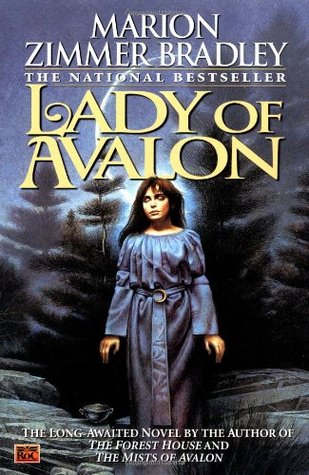
Lady of Avalon

Lady of Avalon is one of the books in the Mists of Avalon series.  That being said, it doesn't seem to matter what order you read these books in.  They jump around in time and were written in random order so they all can stand on their own.  It does help to have read Mists of Avalon for some of the background stories, but it is not necessary.

Lady of Avalon tells the stories of three of the High Priestesses of Avalon.  There is Caillean, who left the Forest House to start a new life for the order in Avalon and her struggles with keeping it safe from the outside world.  Dierna, who loses her sister but gains another and wishes for Avalon and Britain to be protected from Roman rule.  And Viviane, who will orchestrate the birth of Arthur and see him made High King over the land.  All three women have their struggles and opposition despite their strong will to do what they believe best for Britain.

All of these women are strong women, stubborn, prideful, and thinking they know what's best ultimately leads to their downfall.  It happens in every single book.  You would think there would be one who is meek and mild, but there's not.  So I guess only a certain type of person is called into the role of a Lady of Avalon.  The other characters live to support them as well.  It doesn't matter who the other priestesses are, sometimes the druids are rarely mentioned by name, and you can tell the ultimate focus is on these women.  Which is fine, it is their story.  But it'd be nice to see them through the eyes of others more often than you do.

It does seem a theme that nothing ever goes as plan.  This carries across all the books.  And it makes you wonder why their Goddess keeps pressing them to do these things if it isn't working.  Or that a more active role could be taken to preserve the knowledge and keep the faith alive rather than setting a path and letting each person screw it up in their own way.  Just once I would have liked to have seen them succeed and I never really feel as if they do.  I'd also like more back story on the past lives they live as it is mentioned here and there in the books but never really fully expanded on.  But for all my complaining it is still a compelling story and does provide a lot of history for those who have read the other books.  You want to see Avalon, to step through the mists and learn the Mysteries.  So great detail in making you believe the book.

Not a bad one but it certainly isn't as developed as the original book in the series.  I do plan on continuing to read the other books though to have all my questions (hopefully) answered.

Lady of Avalon
Copyright 1997
456 pages

June 09, 2014

Priestess of Avalon by Marion Zimmer Bradley

The Mists of Avalon took the story of Arthur and changed it so that the perspective was from a woman.  And then a series was spawned from it.  Priestess of Avalon is one of those books in the series, although I couldn't tell you what order they should be in as it doesn't seem to matter what order you read them in.

Helena, also known as Eilan, was born of the Lady of Avalon and also caused her death.  She is sent to her father as a child and only returns to Avalon ten years later, to start her training as a priestess.  There she clashes with the new Lady of Avalon, who is her aunt, and it comes to a head when she substitutes herself as his priestess at a ritual.  She is cast out of Avalon and travels with this Roman man as his companion, becoming his wife in all but name and eventually bearing his son Constantine, who will be a great man in his own right some day.  But she still feels the call of Avalon from time to time, and misses her sisterhood of priestesses.

Helena is mostly Helena in this book and not really her British side.  She spends the majority of her life with the Romans and as a wife and a mother rather than a priestess.  She does call upon her powers from time to time but this is more the story of a noble lady rather than an Avalon priestess.  I do appreciate that she liked her dogs though and had many throughout the story.  I really couldn't care either way about any of the other characters.  They weren't described as much as Helena and seemed only there to prop her up on her journey rather than be their own persons.  Except for her son Constantine, he was so fervent in his desires that it was hard to like him.  Although he did get a lot done.

Despite this being a large book it was exceptionally fast paced.  The course of eighty years is told in it and it flies by with big jumps in time with each chapter.  It was a little confusing because of that, but luckily at the start of each chapter the year was given so that helped a little.  This being a story about a cast out priestess was different from the rest of the series too as most usually take place close to Avalon and Helena traveled all over the Roman empire.  I can't say that it held quite the same charm and power that Mists of Avalon did, but it was still a pretty good story in its own right.

If you like the works of Bradley, you'll like this one in the series.  It follows a strong woman and her adventures in a world that doesn't always appreciate strong women.

Priestess of Avalon
Copyright 2002
394 pages

May 07, 2014

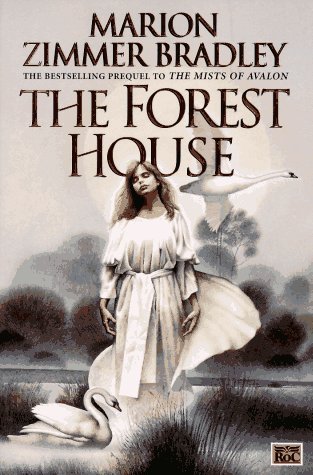
The Forest House by Marion Zimmer Bradley

The Forest House is the second book in the Avalon series, coming after Mists of Avalon, but actually preceding it in the timeline. 

It tells of the time just after the slaughter of Mona, when the priestesses were confined and controlled by the druids in a small complex in the woods.  Rome was still in charge and a rebellion was rising up against them.  So when Eilan, a girl born of a druid family, falls in love with a half Roman half British man, their love is denied and she enters the Forest House to be a priestess instead.  But fate has bigger plans for her and because of one night of passion, she'll have to form large secrets that could come back to haunt her later.

Eilan is ok.  I never really feel like we actually know her.  We know some of her desires, but the larger part of her thoughts are kept from us.  Her assistant we actually know better and was in many ways a stronger woman.  She also seemed to have the best interests of everyone at heart as compared to Eilan.  Dieda, Eilan's cousin, I could have done without.  She was spiteful and didn't really add anything to the story except to be a source of contention, and even then she was never a real threat.  And then there were the Druids.  What a sad lot this group was.  I couldn't find a redeeming quality in any of them.

The plot moved slowly on this book as well.  I normally like Bradley's detail, but in this case it just kept the book from progressing.  Well, when it wasn't jumping through time in fits and starts.  It would be nothing to spend quite a few chapters on a particular timeline and then all of a sudden have it be four years later.  All that being said, it was interesting to hear about the times before the Mists of Avalon, and how the Priestesses were treated differently.  It is amazing to think how easily one group can be controlled by another, even though it's something that happens in the real world every day.

I can't say this was a wonderful book.  It had some history that was interesting, but that was it.  Mists of Avalon was far better.

The Forest House
Copyright 1993
417 pages

January 22, 2014

The Mists of Avalon by Marion Zimmer Bradley

Arthurian Legends.  They're a whole genre unto themselves.  But Bradley does a few things different with her rendition of the famous Arthur and his court.  She tells it from the eyes of the women involved. 

We start with Igraine, married by her sister the Lady of the Lake to a man for political reasons. She has a daughter she names Morgaine, but later the Lady decides a different fate for her and she bears a son named Arthur to the new King of the land.  Morgaine's and Arthur's fates intertwine in ways not expected and will be friends, family, enemies and more.  With Morgaine as a Priestess of Avalon and Arthur drawn to the Christian faith, their relationship is as contentious as any out there, especially since both believe they are doing right by their people.

Morgaine is complicated.  And I like that Bradley didn't paint her as the evil witch so many of the Arthur legends portray her as.  She has depth, flaws, and caring in this book.  And she's probably the main character, which is a relief as I didn't really enjoy the first part of the book that involved her mother.  Igraine wasn't nearly as interesting and tiresome in her complaining.  Arthur was somewhat weak in character in this book.  I don't mean that he wasn't a strong King and did well for his people to the best of his ability, but more that he was easily led by the people around him.  Mordred was involved in this book, but I didn't really find him that menacing or compelling.  He was kind of just there.

I had forgotten just how dialogue driven this book is.  Sure the characters more around do stuff, but they talk and think about things more.  And some of the conversations can get repetitive whether it be about lineage or the difference between Christianity and the Priestesses of the Goddess.  There will be some who are offended by the references to Christianity in this book as well.  They don't have a good relationship with the people of Avalon and the distaste is clearly shown in the book.  You have been warned.  But I do think that Bradley does a great job of capturing some complex characters in this book.  It may be wordy, but for good reason, this is a tale drawn out over half a century with several key players and intrigues that every detail has to count on. 

If you like complicated books, this is one to read.  The movie isn't half bad either.  And, if you do like it, it became a series and there are more books to read that coincide with this one.

The Mists of Avalon
Copyright 1982
876 pages

October 07, 2011

Merlin by Stephen Lawhead

The second book in Stephen Lawhead's Pendragon Cycle, Merlin continues the story where Taliesin left off. However, this book could be read as a stand alone and as such, it is not necessary to read Taliesin (the story of Merlin's parents) before reading this book.

We are shown Merlin as a young child, his teaching from the kindly druid Hafgan and the priest Dafyd, then to his capture by a small tribe and his years in imprisonment, to his adult life. His adult life is where most of the actions take place and because he is long lived, he experiences the life of many men. He is a King at a point, a husband, a hermit, and then we see him in his most well known role, adviser to the High King's of Britain and his plotting that puts them on the throne. While not much is yet said of Arthur, he is born in this book. But there is more than that, this book explores Merlin as a man and his feelings and emotions. Instead of being a wise implacable sage, there is much more to him in this book.

Most of the characters were well done in this book. While some only had minor roles, they were pertinent to the story and really added to Merlin's life. Merlin himself expressed a wide range of emotions and was made to feel more human than he is in other Arthurian novels. My only complaint as far as characterization goes was that for the majority, Christians equaled good and wholesome while everyone else was described as evil or ignorant. It was a bit offensive.

Lawhead is a very descriptive writer and it shows in this series. He brings Merlin to life in a semi-realistic way (there is still some magic although he doesn't call it that due to his Christian flavor of the book). He tells a compelling story and doesn't shrink on any of the details. That being said, this book does get slow in some parts as he tells the story in one pace regardless if that scene is interesting or not. Also, the book tends to get preachy in parts with him waxing eloquently on the pleasures of Christianity. I'm fine with an author inserting his religion in a book, but they should still follow the rule "show, don't tell."

A major flaw with the book that I personally thought was strange was his use of magic despite making his characters entirely Christian. It seemed odd to me that they were doing things, that in that time, should have gotten them burned at the stake for being a witch instead of being lauded as most holy. It just didn't seem logical to me. He also has the Fair Folk (Merlin's family) living a lot longer than everybody else and while I know the bible has this happen to, it seems strange that this wouldn't have made the normal people angry and fearful of the Fair Folk instead of liking them.

I'll probably continue with the series and hope that they be less preachy. There are some great points in the novel and overall it is an interesting story. Plus, I hate starting something I can't finish and there are a few more books to go.

Merlin
Copyright 1988
445 pages

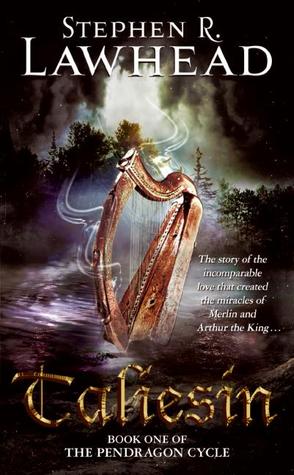
Taliesin by Stephen Lawhead

I really like Arthurian legends. And this one was supposed to be a good one. In some ways it was, and in other ways I did not enjoy the book at all.

This goes way back in the Arthurian legends to tell the tale of Merlin's parents. The beautiful strong Charis of Atlantis. And Taliesin, the enchanting druid bard who is son of a king. The book divides its time between the two and their families, telling of their early years. For Charis, this is the start of a war for her nation, her time spent as a bull dancer, and the fall of Atlantis. For Taliesin, his tale shows the meeting of his parents, his training as a druid, and how he meets Charis. Charis especially meets with a lot of hardship and her story is the more interesting of the two. Taliesin seems to live a charmed life and is thought of as lucky and fortune favored.

The characters were well written. They had a lot of depth to them and Lawhead took the time to give them a full history. Charis is written as cold but capable. Taliesin is charming. There are many other characters that are all essential to the book. My only complaint about the characters is that Lawhead made the Christians perfect in action and the pagans somewhat evil at times. It was a little disconcerting to find that in what I thought was a fantasy novel rather than a religious work.

Lawhead is very descriptive. He gives an engaging plot and does a wonderful fantasy telling of the earlier parts in the Arthurian legends. He makes his characters mostly believable and especially in Charis' case, you want to know what is going to happen to them and care about them as a character. Nothing is overtly offensive in the wording and there isn't a lot of harsh language.

Let me touch on some criticisms however. As stated before Christianity is considered very good in this book. Lawhead took it to the point where it felt very preachy to me. I don't care that a writer reflects his religion in his works, but please don't announce it as the be all end all of religion because that can be offensive to some readers with different beliefs. In this Arthurian legend especially, where a lot of paganism is involved, it is very disconcerting to read a book that expresses the beliefs this way instead of being a fabulous work of fantasy. Also, for the purists who read this, the timeline seems a bit strange. For most, Atlantis takes place hundreds if not thousands of years before the time of Arthur and even though this is a couple generations back from Arthur, it still seems to be too close. There are some other historical data that doesn't quite sync up with normal Arthurian tales as well. While it is a fantasy tale, there are some genres like the Arthurian legends, where are you taking a risk by deviating well accepted norms within the genre. I think Lawhead dances a very fine dance on the line with these aspects. Overall though, these things brought the book down a bit for me and really were a disappointment.

I have the next book in the series so I will be continuing on. I can only hope they improve and become less preachy and truer to the Arthurian legend.

Taliesin
Copyright 1987
452 pages